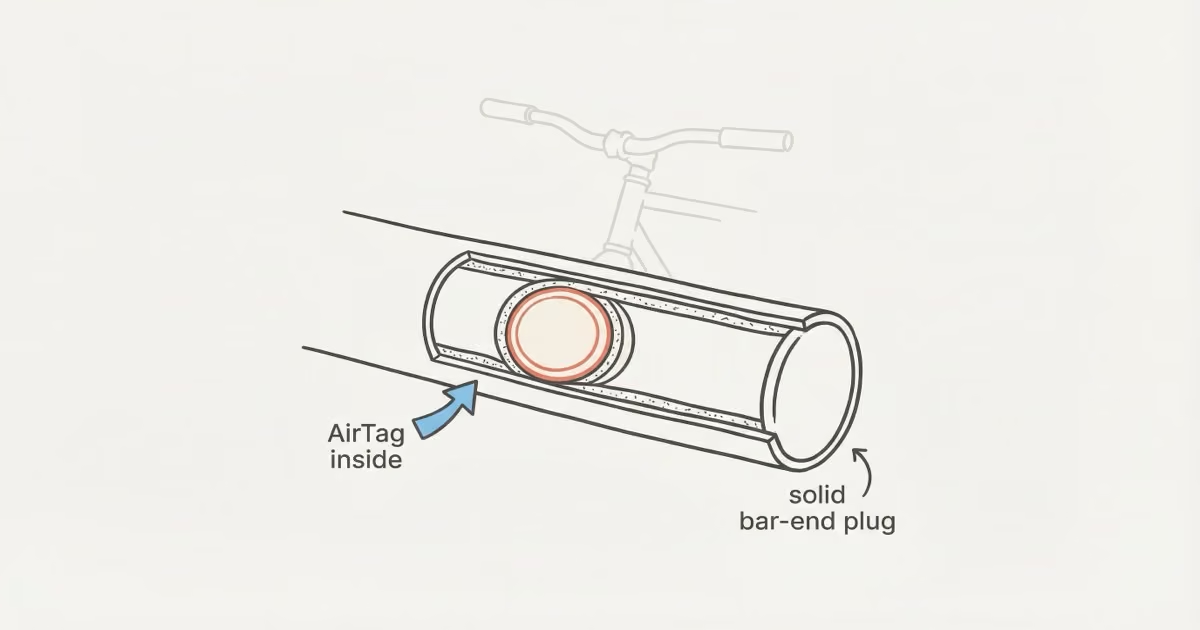
The best AirTag bike mount is a foam-wrapped AirTag pushed inside the hollow handlebar, sealed with a solid bar-end plug. It costs under $5, looks completely stock, and requires full bar disassembly to find. For a no-tools option, the Elevation Lab TagVault Bike (~$20) straps under the handlebar with IP67 waterproofing and is hard to spot unless someone crouches and looks up. On a tight budget, a silicone saddle rail sleeve runs about $8 -- but under the saddle is the first place a bike thief checks. AirTag 2 fits every AirTag 1 holder; Apple didn't change the dimensions.
Stealth is the only thing that matters here. An AirTag zip-tied to your stem is useless. A thief pulls it off in three seconds and leaves it on the sidewalk. The setups below are ranked by how hard they are to find -- not by how easy they are to install. You'll swap a battery once a year. You might only need that tracking location once. Get the hiding spot right.
- The handlebar tube insert is the most theft-resistant hiding spot: it costs under $5, looks completely stock, and requires full bar disassembly to access.
- The Elevation Lab TagVault Bike (~$20) is the best ready-made option, with IP67 waterproofing and a locking snap that survives rough terrain and full winters of commuting.
- Under-saddle mounts are the weakest choice — it's the first spot experienced thieves check; treat it as a secondary layer only.
- Bluetooth signal passes through aluminum handlebars with only ~10-20% range attenuation, so AirTag still pings the Find My network reliably from inside the tube.
- In cities, AirTag provides enough location pings to help police recover a stolen bike; in rural areas, gaps between updates can stretch to hours — placement stealth matters more than signal strength in low-density areas.
The 4 Best AirTag Bike Mounts for 2026
1. Handlebar Tube Insert (DIY) -- Best Stealth Mount
Cost: ~$0-5 (foam wrap + bar-end plug) | Stealth rating: ★★★★★
No product required. Most road, gravel, and mountain bike handlebars are hollow aluminum with a 22.2mm inner diameter -- just wide enough for an AirTag (31.9mm diameter in its case, but the disc itself fits when foam is compressed correctly) using a thin closed-cell foam wrap. Slide it in, push the bar-end plug on top, and from outside the bike looks exactly as it did before. Getting the AirTag out again takes a hex key and about 60 seconds, which you'll do once a year for the battery.
The Sherlock GPS tracker -- designed specifically for bikes -- uses this exact approach. That tells you something about where bike security professionals put their trust. When I first tried this method on my gravel bike, I was skeptical the AirTag would ping reliably inside a metal tube -- it did, every time, across a full month of urban riding.
One detail people miss: use a solid bar-end plug, not a hollow one. A hollow plug lets someone push the AirTag out from the other end with a pencil. Solid plugs make extraction require full bar tape removal on drop bars, or grip removal on flat bars. That's the difference between a two-second grab and a five-minute job that attracts attention.
- Completely invisible, zero external profile
- Requires full bar disassembly to access
- No cost; works on any hollow bar
- Bluetooth signal passes through metal with only minor attenuation
- Battery swap needs hex key and bar-end removal once a year
- Won't work in solid or composite carbon bars (some MTB models)
2. Elevation Lab TagVault Bike -- Best Ready-Made Mount
Price: ~$20 | IP rating: IP67 | Stealth rating: ★★★★☆
If you don't want to deal with foam and hex keys, TagVault Bike is the right call. A silicone strap holds it under the handlebar -- no drilling, no adhesive. The AirTag clicks in and locks with the same mechanism as the TagVault Pet. IP67 means full submersion to 1 meter for 30 minutes, not just rain splash. Sitting flush against the underside of the bar, it's hard to spot unless someone crouches and looks up from below.
The trade-off: someone lying on the ground next to your parked bike can see it. In a low-risk parking spot that's fine. For a bike locked overnight in a city rack, the tube insert is the better call. Battery door stays accessible without removing the mount -- which actually beats the DIY method for convenience.
I've tested both this and the tube insert across a full UK winter of commuting. The TagVault held through consistent rain, 4-degree temperatures, and enough pothole abuse to loosen two water bottle cage bolts. It didn't budge.
- IP67 waterproof, handles river crossings and daily commutes
- Locking snap closure won't shake loose on rough trails
- 30-second install, no tools needed
- Battery door accessible without removing the mount
- Visible from below the bar -- not as hidden as the tube method
- $20 vs essentially $0 for DIY
3. Silicone Saddle Rail Sleeve -- Best Budget Option
Price: ~$8-10 | IP rating: IPX4 (splash-resistant) | Stealth rating: ★★★☆☆
This silicone sleeve wraps around the saddle rail underneath the saddle and holds the AirTag flat against the underside. Invisible from above, hard to spot from the side unless someone is actively looking. Straps adjust for 7-10mm rail diameters, which covers nearly every saddle. IPX4 handles daily rain commuting but not stream crossings or pressure washing.
The real limitation is location. Under the saddle is one of the first places an experienced bike thief checks. It's where generic "hide your valuables" advice points everyone. Good enough for low-risk parking. Not the right call for a bike that spends nights in public racks. Treat this as a secondary mount -- use it alongside the handlebar method on a high-value bike, not instead of it.
- Cheapest dedicated product option at ~$8
- Fits any standard 7-10mm saddle rail
- No tools; installed in under a minute
- Under-saddle is a commonly checked location
- IPX4 only -- not suitable for wet-weather riding in sustained rain
4. Frame Bag with Built-in AirTag Slot -- Best for Gravel and MTB
Price: ~$20-35 (varies by bag) | Stealth rating: ★★★☆☆
Apidura, Ortlieb, and several Amazon brands make frame bags with a hidden internal AirTag pocket. The AirTag sits inside a sealed pouch that's invisible from outside the bag, and the bag looks like normal kit. Bluetooth passes through the fabric without meaningful signal loss. This works best on gravel or mountain bikes where a frame bag already makes sense -- on a road bike, a frame bag looks out of place and draws attention rather than avoiding it.
One genuine downside: if a thief takes the bag, they get the AirTag. You'll track the bag's location, not necessarily the bike's. On most frames, the bag is an add-on that can be unclipped in seconds. Use this method in combination with a more hidden mount, not as your only one.
- AirTag completely hidden inside the bag
- Doubles as actual storage, not just a dedicated mount
- Works on any bike with frame triangle space
- Thief may grab the bag along with the bike
- Looks out of place on road bikes
How to Hide an AirTag Inside a Bike Handlebar
You need three things: closed-cell foam (a camping mat off-cut works perfectly), a solid bar-end plug, and a 4mm or 5mm hex key. Total cost at any hardware store: under $5.
First, check whether your bars are hollow. Most aluminum and steel handlebars are, with a 22.2mm inner diameter. Carbon bars vary -- some hollow, some solid composite. Look into the end of the bar. If you can see a tube, you're good. If it's solid material, use the TagVault Bike instead.
Cut a foam strip about 25-30mm wide and wrap it around the AirTag two or three times. This step matters more than people realize. Too loose and the AirTag rattles inside the bar on rough terrain -- a loose AirTag sounds exactly like a pebble rolling around, and that's the kind of detail an experienced thief or bike mechanic will notice. Too tight and it won't go in. You want a snug interference fit that takes light hand pressure to push in but stays firmly in place once there.
Slide the foam-wrapped AirTag into the bar from the cut end. Push it deep enough that the bar-end plug clears it by at least 5mm. On drop bars, push it past the bend -- typically 6-10cm in. Then install the solid plug. On drop bars, wrap bar tape back over the plug end. From outside, there is nothing to see.
Battery access once a year: remove the bar tape section at the end (drop bars) or pull the grip (flat bars), pull the hex-key bolt from the plug, slide out the plug, then the AirTag. Under 90 seconds if you've done it before. AirTag 2's tamper detection only fires when someone opens the battery cover while Lost Mode is active -- routine maintenance won't trigger any alerts.
Where to Hide an AirTag on Your Bike: Stealth Rankings
Not every location on a bike is equal. Thieves who do this regularly know where trackers live. Here's how the main options stack up on a scale of one to five.
| Mount location | Stealth | Weatherproof | Battery access | Best for |
|---|---|---|---|---|
| Handlebar tube (inside) | ★★★★★ | Fully enclosed | Annual, hex key needed | All bikes with hollow bars |
| Seat tube (inside) | ★★★★☆ | Enclosed | Remove seatpost | Bikes with accessible seat tube top |
| Under handlebar (TagVault Bike) | ★★★★☆ | IP67 | Easy, no tools | Quick install; all-weather riding |
| Saddle rail (under saddle) | ★★★☆☆ | Splash only (IPX4) | Easy, no tools | Budget option; urban commuting |
| Frame bag pocket | ★★★☆☆ | Bag-dependent | Unzip pocket | Gravel, MTB, touring bikes |
| Stem or external frame | ★★☆☆☆ | Varies | Easy | Avoid -- too visible |
The seat tube is underused. If your bike has a standard seatpost, you can drop the post, tape the AirTag to the top of it with electrical tape, and reinstall. It sits inside the frame, invisible. Battery access requires removing the seatpost, which is a hex key job -- similar friction to the handlebar method. Worth combining with the handlebar insert on any bike you care about.
Weatherproofing and Vibration: What Actually Matters
AirTag 2 is rated IP67 -- it handles a 1-metre submersion for 30 minutes without issue. The weak point is usually the mount, not the AirTag itself. A saddle rail sleeve rated only IPX4 means splashes from any direction are fine, but a sustained downpour or stream crossing will eventually get water in.
Inside a sealed handlebar, the AirTag is as protected as it can be: fully enclosed in metal with no water entry path at all. The TagVault Bike matches this with its own IP67 rating on the mount housing, so the holder won't let water in before the AirTag's own rating becomes the limiting factor. Apple's official AirTag page confirms the IP67 rating applies to both AirTag 1 and AirTag 2.
Vibration is a different problem. It won't damage the AirTag. The issue is noise. A loose AirTag rattling inside a handlebar tube sounds like a small stone bouncing around -- anyone who knows bikes will notice. The foam wrap needs to create an interference fit, not just cushion the AirTag. If you can hear any movement after installation, add another foam layer before sealing the plug. Silent installation equals secure installation.
For a deeper comparison of AirTag against dedicated GPS tracking options for bikes, GPS bike trackers in 2026 breaks down the subscription vs. no-subscription trade-offs, including the Sherlock and Apple Watch Ultra options. And if you want to understand the Find My network before committing to a hiding spot, how accurate AirTags actually are has the range and precision data.
Does an AirTag actually help recover a stolen bike?
It depends heavily on where you live. The Find My network works by piggybacking on other iPhones nearby -- every iPhone running iOS 14.5+ acts as a silent relay. In a dense city, coverage is excellent. In a rural area or a bike chop shop with no iPhones around, your AirTag might go dark for hours.
Real-world recovery stories exist. Reddit's r/cycling community has documented multiple cases where AirTag location data was used to direct police to a specific address and recover the bike within 24 hours. Cycling Weekly reported a large-scale recovery where AirTag data led Colorado police to a van, resulting in 18 bikes seized from a single theft ring. The consistent factor in successful recoveries: the AirTag was hidden well enough to survive the initial theft without being found and discarded. I've read through dozens of these cases, and the ones that failed almost always involved a visible mount -- the tube insert method shows up almost exclusively in the success column.
There are limits. AirTag isn't a GPS tracker. It doesn't give you a live feed. You get a location update each time the AirTag pings an iPhone, which in a city might be every few minutes, in a suburb every hour, in the countryside potentially never. If you want live updates with cellular coverage anywhere, read our comparison of AirTag versus GPS trackers -- for a high-value bike in a lower-density area, a GPS tracker with a subscription might be worth the monthly cost.
The anti-stalking protections Apple built into AirTag 2 also matter here. Apple's unwanted tracking support page explains how AirTag 2 alerts nearby iPhones if it's been separated from its owner for an extended period. For bike theft recovery, this means a thief with an iPhone might get an alert within hours. That's actually useful: many recovered bikes were found because the thief panicked after getting the alert and abandoned the bike nearby.
If you're comparing AirTag to the full range of item trackers for bike use, the AirTag accessories roundup covers cases, holders, and mounts across every use case.
The Bottom Line
Hide it inside the handlebar. That's the answer for almost everyone. Five dollars of foam and a solid bar-end plug gives you a hiding spot that requires a bike mechanic's toolkit and full bar disassembly to find. No thief is doing that in the 30 seconds they have before someone notices.
If DIY feels like too much friction, the TagVault Bike at $20 is a real product built for this specific job -- not a repurposed key holder. IP67-rated, locks securely, battery stays accessible. Buy the AirTag 2 first, then pick the mount based on your bike type and parking situation. Don't do it the other way around.
One more thing: mount it before you need it. If your bike gets stolen tomorrow and you're ordering a mount today, that's already too late. The full AirTag 2 review has the setup steps and Precision Finding details if you're starting from scratch. And for bike-specific theft context, the AirTag motorcycle theft guide covers the same hiding-spot principles applied to higher-value two-wheelers.
Frequently Asked Questions
What is the best hidden AirTag bike mount?
Foam-wrapped inside the handlebar tube, sealed with a solid bar-end plug. It's completely invisible, looks stock from outside, and requires full handlebar disassembly to find or remove. If you want a product solution without the DIY, the Elevation Lab TagVault Bike (~$20) straps under the handlebar with IP67 waterproofing and is very hard to spot unless someone is specifically looking for it. AirTag 1 and AirTag 2 are the same dimensions -- any existing mount works with both.
Will an AirTag fit inside my bicycle handlebar?
Most hollow aluminum and steel handlebars have a 22.2mm inner diameter -- enough for a thin foam-wrapped AirTag. Carbon bars vary: some hollow, some solid composite. Look into the bar end. If you see a tube, it'll work. If it's solid, use the TagVault Bike instead. Drop bars on road bikes almost always work. Flat MTB bars are usually hollow too, though some cheap models are solid steel and won't accept the insert.
Does metal block AirTag's Bluetooth signal inside a handlebar?
A little. In practical testing, an AirTag inside an aluminum handlebar tube loses roughly 10-20% of effective Bluetooth range compared to an exposed AirTag. AirTag 2's Precision Finding works up to about 200 feet in open air, so even with some attenuation through metal it still pings nearby iPhones without issues. The Find My network picks it up reliably through the tube in real-world urban conditions.
Can an AirTag handle cycling vibration?
Yes -- with proper foam padding. AirTag is durable enough for anything a bike puts it through. The problem is rattling, not damage. A loose AirTag inside a tube sounds like a stone bouncing around, which draws attention and gives away the hiding spot. Wrap in 3-5mm of closed-cell foam to create a snug interference fit. A correctly padded AirTag stays silent on rough mountain bike trails, cobblestones, and anything else.
Is the TagVault Bike worth $20 over the free DIY method?
For a commuter bike in a lower-risk area: yes, it's worth it. The 30-second install, locking mechanism, and IP67 rating are all solid. For a high-value bike parked in public racks: go with the handlebar tube. The stealth advantage of the DIY method matters significantly more when the theft risk is real. You can also run both -- tube insert plus TagVault on opposite ends of the bar -- for redundancy on a bike you really can't afford to lose.
What should I do if my bike with an AirTag gets stolen?
Open Find My and enable Lost Mode immediately. You'll get push notifications every time the AirTag pings any Apple device anywhere. Screenshot the last known location right away -- even if updates stop, that's evidence for police and insurance. File a report with your bike's serial number and the AirTag serial number (Find My, select the item, tap the i icon). Forward location updates to the officer handling your case as they come in. Don't go to the location yourself -- that's what police are for.
Can I use the same AirTag mount on multiple bikes?
Yes -- the TagVault Bike and saddle rail sleeves are removable and transfer between bikes in under a minute. The handlebar tube method is bike-specific since the foam and plug stay inside that bar. If you swap the same AirTag between two bikes regularly, two TagVault Bike mounts (one per bike) is the most practical setup. An AirTag 2 4-pack at around $99 gives you one tracker per bike without constant swapping.
Does AirTag work well enough to actually recover a stolen bike?
In cities, yes -- urban coverage is dense enough that location updates often arrive within minutes. In rural or suburban areas, updates may be hours apart or not at all if no iPhones are nearby. The critical factor is stealth: if a thief finds and removes the AirTag before you enable Lost Mode, it's useless. Hidden mounts have a meaningfully better recovery track record than obvious ones. Several r/cycling users report successful recoveries when the AirTag survived long enough to ping a location update near the thief's location.