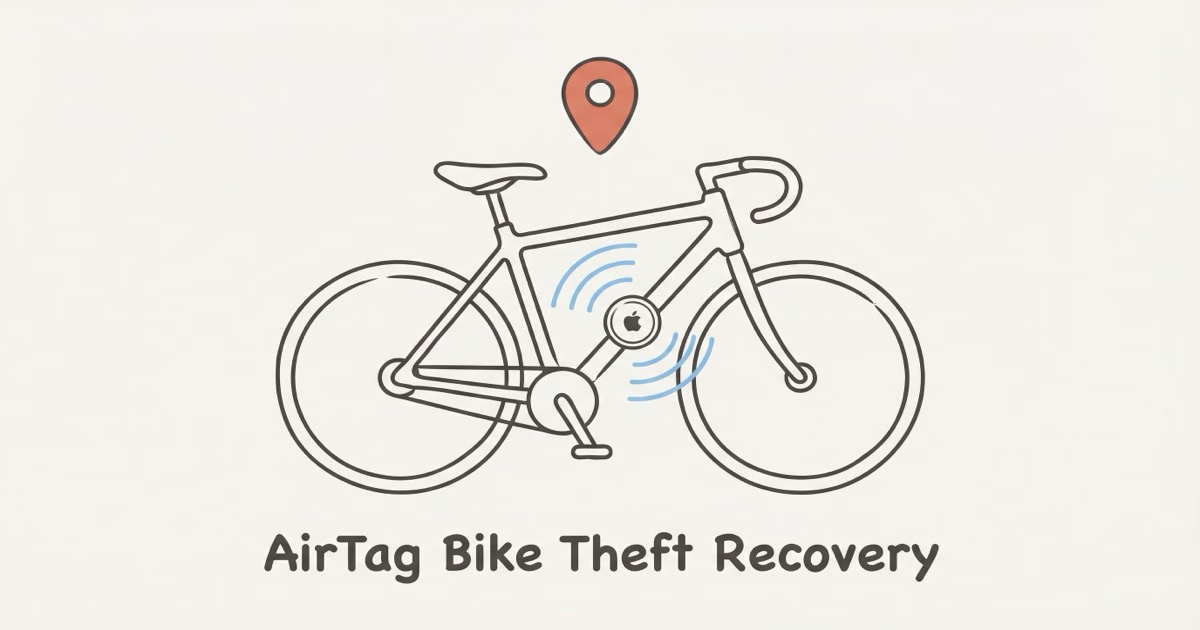
About 2.4 million bikes get stolen in the US every year, according to a 2025 Bike Index report. Recovery rate? 5.7%. A $29 AirTag won't stop someone from cutting your lock, but it gives you something most stolen bike owners don't have: a location signal after the theft. Whether that signal leads to a recovery depends on where the bike ends up and how fast you act. Police cooperation helps too, but varies wildly by city.
How AirTag Tracks a Stolen Bike
AirTag doesn't have GPS. No cellular radio either. It broadcasts a Bluetooth signal that nearby iPhones pick up and anonymously relay to Apple's servers. You see the location in Find My on your phone.
Tracking accuracy comes down to iPhone density around your stolen bike. In a city? Plenty of iPhones walking past. Updates every few minutes. Parked in a rural garage 30 miles outside town? Could be hours between pings. Or nothing at all.
One thing people miss: the AirTag doesn't need the thief's iPhone specifically. It needs any iPhone within about 30 feet (60 feet on AirTag 2). A phone in a passing car, a pedestrian on the sidewalk, someone in the apartment above the garage. In any reasonably populated area, there are enough iPhones moving around to get regular pings.
The AirTag 2 bumped UWB Precision Finding range to about 60 meters, which helps once you're close enough to use the directional arrow. But the initial "where did my bike go" tracking still depends on the crowd-sourced Find My network, over a billion Apple devices worldwide. If your AirTag location seems stuck, the location not updating guide explains what's happening.
Where to Hide an AirTag on Your Bike
Hiding spot matters more than the AirTag itself. A thief who finds and tosses it in the first five minutes has beaten the system. Most thieves spend 2-3 minutes checking a stolen bike for trackers before moving it. Your hiding spot needs to survive that window.
Five spots, ranked by how hard they are to find:
- Inside the handlebar tube: Most handlebars are hollow with a 22.2mm inner diameter. AirTag is 31.9mm wide, so it won't fit in narrow drop bars, but straight bars and many MTB bars are wider. Wrap it in thin foam, slide it in, put the bar-end plug back. From outside, the bike looks completely stock. Best option if your bars accommodate it.
- Seat post tube: Drop it inside the seat tube through the top opening. Hardest spot for a thief to check. The downside: harder for you to retrieve for battery changes too. Test Bluetooth signal strength before committing. Some carbon frames weaken the signal.
- Inside a fake reflector or bell: The AirBell (about $25) looks like a normal bike bell but hides an AirTag compartment inside. Thieves don't steal bells. Easiest install. No tools, no frame modifications.
- Under the saddle: Silicone sleeves wrap around the saddle rail and hold the AirTag flat against the underside. Invisible from above. A thief who flips the seat will spot it, but most quick grabs don't involve checking under there.
- Behind a water bottle cage: Third-party holders that bolt between the cage and frame. More visible than internal spots, but the signal gets out clean and battery swaps are easy.
Always test after installation: open Find My, select the AirTag, tap "Play Sound." If it plays, the signal is getting through. The AirTag bike mount guide reviews specific products for each location. The hiding tactics overlap with our car AirTag hiding guide too, if you're looking for more ideas.
The Anti-Stalking Catch
Here's the part most "put an AirTag on your bike" advice skips.
Apple built anti-stalking protections into AirTag. If an AirTag travels with someone else's iPhone for 8-24 hours without its owner nearby, that person gets an alert: "AirTag Found Moving With You." If the thief carries an iPhone (and most do), they'll know about your AirTag within a day.
After that window, the AirTag also starts chirping. About 60dB. Easy to miss outdoors or in traffic, but noticeable in a quiet apartment.
So you have roughly 8-24 hours before the thief gets tipped off. After that, a savvy thief searches for the AirTag and dumps it. A less tech-savvy thief might ignore the notification or not even notice it. Plenty of recovery stories involve exactly that kind of thief.
Android users don't get the automatic alert. Apple released a Tracker Detect app for Android, but it requires manual scanning and most people don't have it installed. Google also added native unknown tracker detection to Android 14+, but reports suggest it's slower and less reliable than the iPhone alerts. For now, Android-carrying thieves are less likely to discover your AirTag quickly.
What to Do When Your Bike Gets Stolen
The tracking window closes fast. Here's the sequence that works.
- Open Find My immediately. Check the AirTag's last known location. Screenshot it with the timestamp.
- Call the police non-emergency line. File a report. Give them the bike's serial number, photos, and the AirTag's current location. Get a case number.
- Do not go to the location yourself. Bike theft rings operate in groups. Confrontations have turned violent. A $2,000 bike is not worth a hospital visit.
- Enable Lost Mode. In Find My, tap the AirTag, scroll down, tap "Mark as Lost." Add your phone number. This pushes you a notification every time any iPhone detects the AirTag, and displays your contact info if someone taps the tag.
- Keep monitoring and forwarding. The thief may move the bike. Each time the AirTag location updates, send it to the officer handling your case.
- If police respond, go with them. Use Precision Finding to narrow down the exact spot. The UWB arrow on AirTag 2 works through walls and is accurate to about a meter.
Bring printed screenshots of the Find My map with timestamps, not just your phone screen. Some officers aren't familiar with AirTag or Find My. A clear printout showing "my bike was here at 2:47pm, then moved here at 3:15pm" reads as evidence, not just an app someone's waving around.
Police cooperation varies wildly. In Colorado, Vail police used AirTag signals to chase a van of stolen bikes down I-25 and linked the suspect to nearly three dozen thefts across Eagle, Summit, and Boulder counties. In other cities, officers may not know what an AirTag is or may tell you it's a civil matter. Results depend on your department.
Real Recovery Stories
AirTag bike recoveries show up in the news every few weeks now:
- A London journalist tracked his stolen bike across the city using Find My. When police couldn't help immediately, he went to the location himself (risky, not recommended) and found his bike. His AirTag was hidden inside a saddle bag.
- In Denver, a man traced his stolen bike to a nearby apartment complex using an AirTag. Police arrested the suspect on site.
- The Colorado case: two AirTags on Specialized Stumpjumpers kicked off a statewide investigation and the recovery of dozens of bikes stolen over months.
The recoveries that worked all had the same two things: a well-hidden AirTag and an owner who called police within hours. The ones that failed? Usually the owner waited a day or two before doing anything, and by then the bike had moved or the AirTag was in a dumpster.
AirTag vs Dedicated Bike GPS Trackers
AirTag costs $29 with no subscription. Hard to beat that. But Apple designed it for finding your keys in a couch cushion, not for tracking a stolen vehicle across a city.
Dedicated bike GPS trackers like the Sherlock hide inside the handlebar, use cellular GPS for real-time tracking, and don't have anti-stalking alerts that tip off thieves. The trade-off: Sherlock runs about $150 plus a monthly subscription. AlterLock is cheaper but uses a different network with less coverage.
| Feature | AirTag 2 | Sherlock (GPS) |
|---|---|---|
| Price | $29, no subscription | ~$150 + ~$5/month |
| Tracking method | Bluetooth relay (Find My) | Cellular GPS (real-time) |
| Rural/low-density tracking | Sporadic (needs iPhones nearby) | Continuous (cellular coverage) |
| Anti-stalking alert to thief | Yes (8-24 hours) | No |
| Battery life | ~1 year (CR2032, replaceable) | ~2 weeks (rechargeable) |
| Works with | iPhone only | Any smartphone |
For a $500 commuter bike, AirTag is a no-brainer at $29. For a $5,000 carbon road bike, a dedicated GPS tracker is probably worth the subscription cost. Some riders run both. AirTag as the backup in case the thief finds the primary tracker. The AirTag alternatives guide compares more tracker options across price points.
Frequently Asked Questions
Will AirTag prevent my bike from being stolen?
No. AirTag is a recovery tool, not a deterrent. It won't stop someone from cutting your lock, and there's no visible indicator that warns thieves a tracker is present. A good U-lock through the frame and rear wheel, secured to an immovable object, is still your first line of defense. AirTag is your second line, for when the lock fails.
Can a thief disable my AirTag?
If they find it, yes. Twist the back cover, pop the battery, five seconds. The only defense is hiding it where they won't look. Thieves typically spend 2-3 minutes checking for trackers. A well-hidden AirTag inside a handlebar tube or under a fake reflector survives that sweep.
Does AirTag work if the thief doesn't have an iPhone?
AirTag doesn't need the thief's phone. It needs any iPhone within Bluetooth range, about 30 feet for the original AirTag, 60 feet for AirTag 2. That includes passing cars, pedestrians, apartments near where the bike gets parked. In any city, there's almost always an iPhone within range.
Should I confront the thief to get my bike back?
No. Call the police. Bike theft operations have turned violent when owners showed up. Your bike has a dollar value. Your safety doesn't. Hand the location data to police and let them handle the physical recovery.
How long does the tracking window last before the thief gets alerted?
8-24 hours if the thief carries an iPhone. Apple randomizes the delay within that range. After the alert fires, the thief can search for the AirTag. Android users don't get automatic alerts. They'd need Apple's Tracker Detect app installed, and almost nobody does.
Can I use AirTag on an e-bike?
Same concept, more hiding options. E-bikes have larger frames and compartments. The battery housing (if it has a lockable cover) is a popular spot. One thing to watch: don't put the AirTag directly against the e-bike's metal battery pack. The metal can weaken the Bluetooth signal. Tuck it in a plastic compartment nearby instead.
Should I use one AirTag or two?
Two is better if the bike is worth it. Hide them in different spots. If the thief finds one and stops looking, the second keeps tracking. At $29 each, $58 in tracking for a bike worth 10-100x that is cheap insurance.
Bottom Line
AirTag won't stop your bike from being stolen. But at $29, it's the cheapest tracking insurance you can bolt onto a frame. Hide it deep, act fast when it happens, and call the police with the location data. That 5.7% national recovery rate gets a lot better when you can hand an officer a live location pin instead of just a serial number.
AirTag 2 (check current price) is the one to get. The longer UWB range and louder speaker both matter when you're trying to pinpoint a bike in someone's garage. For more tracking ideas beyond bikes, the best uses guide covers 15 other setups.