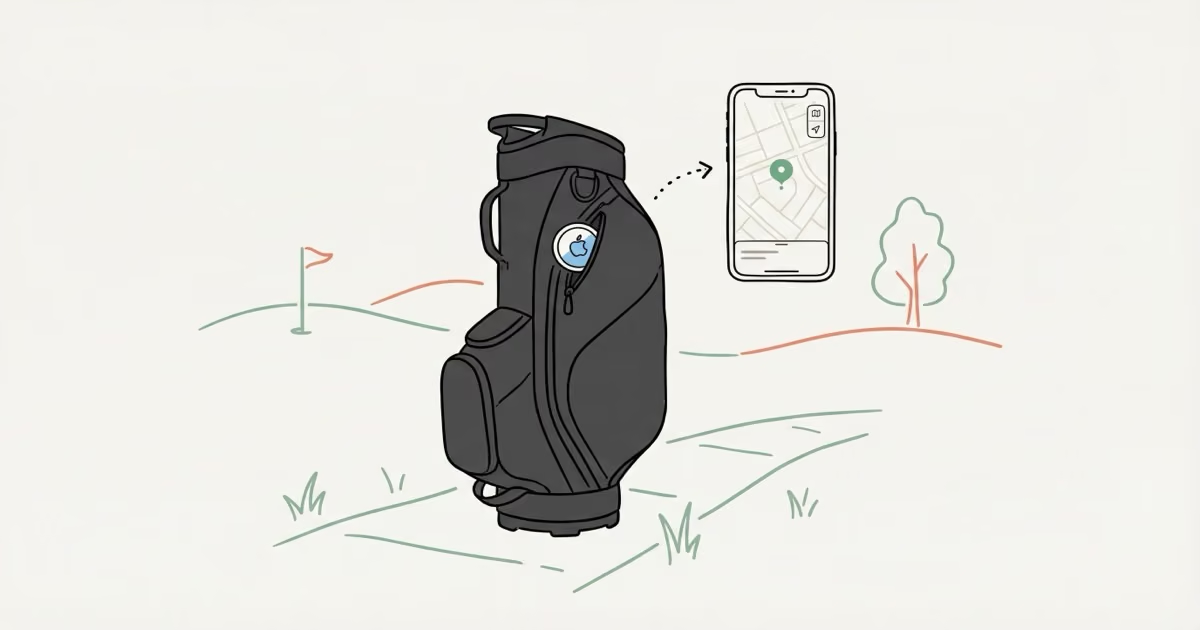
Golf equipment theft adds up fast. At courses, bags disappear from parking lots, cart staging areas, and pro shop check-ins. An AirTag hidden in a pocket won't prevent any of this, but it does something your insurance company can't: tell you exactly where the bag went.
Why Golf Bags Are Easy Targets
A loaded golf bag is worth $2,000-$8,000. Custom irons, a $500+ driver, a $300 rangefinder, a $50 putter grip. Thieves know this. Organized retail theft rings hit golf retailers hard in 2022-2023, with roughly 900 reported crime events and theft values running 5x higher than 2019 levels. The bag sits unattended on a cart, in a parking lot, or at an airline carousel, and it takes under 30 seconds to grab and go.
The most common theft scenarios:
- Parking lot smash-and-grab: Bags visible in car trunks or back seats. This is the number-one method. Thieves cruise golf course parking lots looking for easy targets.
- Cart staging area: Bags left at bag drop before or after a round. Someone dressed like a golfer walks off with the wrong bag. Staff don't always notice.
- Airport baggage claim: Golf travel bags are large, expensive-looking, and arrive on the oversized belt. LPGA pro Charley Hull had her clubs (valued at $12,000-$18,000) stolen from Miami International Airport in 2025. She tracked them via AirTag to a neighborhood near 103rd Street but couldn't recover them before the trail went cold.
- Car overnight: Leaving clubs in a trunk overnight, especially in a driveway or hotel parking lot, is a consistent source of claims.
Most stolen clubs end up on eBay, Facebook Marketplace, or OfferUp within hours. Once they're sold to a buyer who doesn't know they're stolen, recovery without a tracker is almost impossible. Custom-fit irons with specific shaft lengths and lie angles are particularly frustrating to replace, because the wait time for a new fitting and build can run 4-8 weeks.
Real Recovery Stories
The Briarwood Country Club case out of Arizona is worth knowing. Phil Stika, general manager at Briarwood Country Club in Sun City West, started hiding AirTags in member bags after repeated thefts at the club. When 12 sets of clubs were stolen in a single incident, Stika tracked the AirTags to a neighborhood in south Phoenix. Police recovered the clubs and arrested two suspects facing felony charges. The AirTag data also led to untagged stolen bags stored at the same address.
A Golf.com travel writer tracked airline-misrouted clubs via AirTag and found they were sitting in Atlanta while the airline's system claimed they were in Seattle. The AirTag contradicted the airline's own tracking, and the clubs were returned within a day.
Not every case ends well. Hull's Miami airport theft shows the limit: even with an AirTag signal pointing to a specific block, if police don't respond quickly or the thief moves the bag, the window closes. AirTag helps most when the bag stays in one place long enough for someone to act. In Hull's case, the thief likely moved the clubs to a second location within hours, and the AirTag stopped updating once it was inside a building with no iPhone traffic passing through.
Where to Hide an AirTag in Your Golf Bag
Golf bags have more pockets than most luggage. That's an advantage. A thief grabbing a bag in a parking lot isn't going to check six different zippered compartments for a tracker.
- Valuables pocket (best spot): The small, fleece-lined zippered pocket found on most cart and staff bags. Concealed, protected from rain, and the soft lining transmits Bluetooth without interference. This is where your wallet and phone go during a round, so it's rarely accessed by anyone else.
- Rain hood storage pocket: The secondary pocket where the rain cover lives. Almost never opened by anyone except the owner. Good concealment.
- Internal D-ring clip: Many bags have D-rings inside for keys or bag tags. An AirTag loop or small carabiner clips on cleanly. Easy battery access when the CR2032 needs replacing.
- Inside a headcover: Tuck the AirTag into the padding of a driver or putter headcover. Stays with the clubs even if moved between bags. Downside: if the thief ditches the headcovers, the tracker goes with them.
- Bottom of the ball pocket: Under a layer of golf balls. Nobody digs to the bottom of this pocket.
Where not to put it: club dividers and external pockets. Stiff plastic dividers and proximity to metal shafts reduce Bluetooth range. External pockets are the first thing a thief checks. After placing the AirTag 2, open Find My and tap "Play Sound." If you hear it through the bag fabric, the signal is fine.
Setting Up Separation Alert
Separation Alert is the reason to use AirTag on a golf bag, not Find My. It notifies your iPhone the moment you walk away from the bag:
- Open Find My, tap Items, select your AirTag
- Tap "Notify When Left Behind" and toggle it on
- Add your home and your regular club as Safe Locations (prevents false alerts when you leave the bag in your garage or club locker overnight)
- Leave the alert active for courses you don't visit regularly
The alert fires within a minute or two of the Bluetooth connection breaking. That catches two scenarios: an accidental bag mix-up on the cart, and someone walking off with your bag from a staging area. In both cases, you find out before you've finished your post-round drink.
One practical tip: if you play the same course regularly, add it as a Safe Location. Otherwise Separation Alert fires every time you walk from the bag drop to the clubhouse. You can have multiple Safe Locations active, so add your home, your primary club, and any course you visit more than once a month. For travel rounds at unfamiliar courses, leave the alert active. That's exactly when you want it.
AirTag for Golf Travel
Golf bags as checked luggage go missing more often than standard suitcases. They're oversized, handled separately from regular luggage, and the recovery window is narrow.
| Travel Scenario | AirTag Value | Why |
|---|---|---|
| Airline checked (domestic) | High | Airports have dense iPhone traffic; updates come frequently |
| Airline checked (international) | Medium-High | Depends on destination iPhone market share; strong in US, UK, Japan, Australia |
| UPS/FedEx shipping | Medium | Warehouse and truck iPhones provide occasional updates, not real-time |
| Resort/hotel storage | High | Staff iPhones provide consistent coverage in hospitality areas |
Airlines are required to trace mishandled bags, but their systems lag by hours. An AirTag shows you the actual location independently. "Your bag is at the Memphis hub, not Charlotte" is more actionable than waiting for the airline's tracking to catch up. The checked luggage guide covers what to expect with AirTag in airline cargo holds.
For international golf trips, AirTag works best in countries with high iPhone market share. Scotland, Ireland, Japan, and Australia all have strong Find My coverage. Southeast Asian destinations and parts of South America have thinner networks. If you're shipping clubs ahead via a golf logistics company like Ship Sticks, the AirTag gives you independent confirmation that the bag arrived at the resort before you do.
What to Do If Your Golf Bag Is Stolen
Move fast. The first hour matters most.
- Enable Lost Mode in Find My right away. This displays your phone number if anyone scans the AirTag, and you get notified each time an iPhone passes near it.
- Screenshot the Find My location and note the timestamp. This is evidence.
- File a report with club security or management and local police. Provide Find My screenshots with the location data.
- Don't go confront the thief yourself. Same advice as bike and backpack theft scenarios. Let police handle it.
For airline loss, file a Property Irregularity Report at the baggage claim desk immediately. Show the agent your Find My screenshot. "The bag is at your Memphis hub" gets faster action than "I don't know where it is." Airlines have internal tools to locate bags by facility, but only if someone tells them which facility to check.
AirTag tracking data also strengthens insurance claims. Homeowners and renters policies typically cover golf equipment theft (including from cars), but you need a police report and documentation. Find My screenshots with timestamps provide exactly that. If your clubs are worth $5,000+, consider a scheduled personal property endorsement on your homeowners policy, since standard sub-limits for sporting equipment often cap at $1,500-$2,500.
Frequently Asked Questions
Where is the best place to hide an AirTag in a golf bag?
The fleece-lined valuables pocket. It's concealed, protected from weather, and the fabric doesn't block Bluetooth. The rain hood storage pocket is a close second. Avoid club dividers where metal shafts can reduce signal range.
Will AirTag work if my golf bag is checked as airline luggage?
Yes, and it's one of the strongest use cases. Airport baggage areas have dense iPhone traffic from passengers and staff. Updates come at loading and unloading stages. Inside a sealed metal cargo hold during flight, updates pause, but resume the moment the bag reaches a handler. The battery lasts over a year, so you don't need to worry about charging before a trip.
Can AirTag catch someone stealing my clubs from a cart?
If Separation Alert is on, you'll get a phone notification the moment you walk away from the bag, which catches both accidental mix-ups and theft. For active theft tracking, enable Lost Mode immediately and let the Find My network locate the bag.
Are there AirTag holders designed for golf bags?
A few. Some third-party makers sell grip end mounts that screw into the butt end of a club shaft. 3D-printed holders on Etsy clip to bag hardware for $8-20. But honestly, a bare AirTag 2 (same 31.9mm size as the original) dropped into a zippered pocket works just as well and costs nothing extra.
Does AirTag interfere with golf GPS devices or rangefinders?
No. AirTag uses Bluetooth 5.0 and UWB, which operate on different frequencies than golf GPS watches (satellite) and laser rangefinders. No interference in testing or any reported cases. You can keep the AirTag in the same pocket as your rangefinder without issues.
What about golf-specific trackers like Arccos or Shot Scope?
Those are shot-tracking systems for performance analysis, not theft prevention. They track which club you hit and where the ball lands. They don't track the location of your bag. AirTag is the only sub-$30 option that does bag-level location tracking with no subscription.
Will my insurance cover stolen golf clubs if I have AirTag data?
Standard homeowners or renters insurance covers golf equipment theft, including from cars. You still need a police report and receipts. AirTag screenshots with timestamps strengthen the claim by documenting exactly when and where the theft occurred. Check your policy's sporting equipment sub-limit, though. Many cap at $1,500-$2,500 unless you add a scheduled endorsement.
The Bottom Line
A $29 AirTag in the valuables pocket of your golf bag covers the two scenarios that cost golfers the most: parking lot theft and airline baggage disasters. Enable Separation Alert so you know the moment the bag leaves your side. Enable Lost Mode the moment something goes wrong. The Briarwood recovery in Arizona, where AirTags led police to 12 stolen sets of clubs, started with a general manager who spent $29 per bag on a hunch. That's cheap insurance on equipment worth 100x more. The best uses for AirTag guide covers other scenarios where the same $29 pays off.