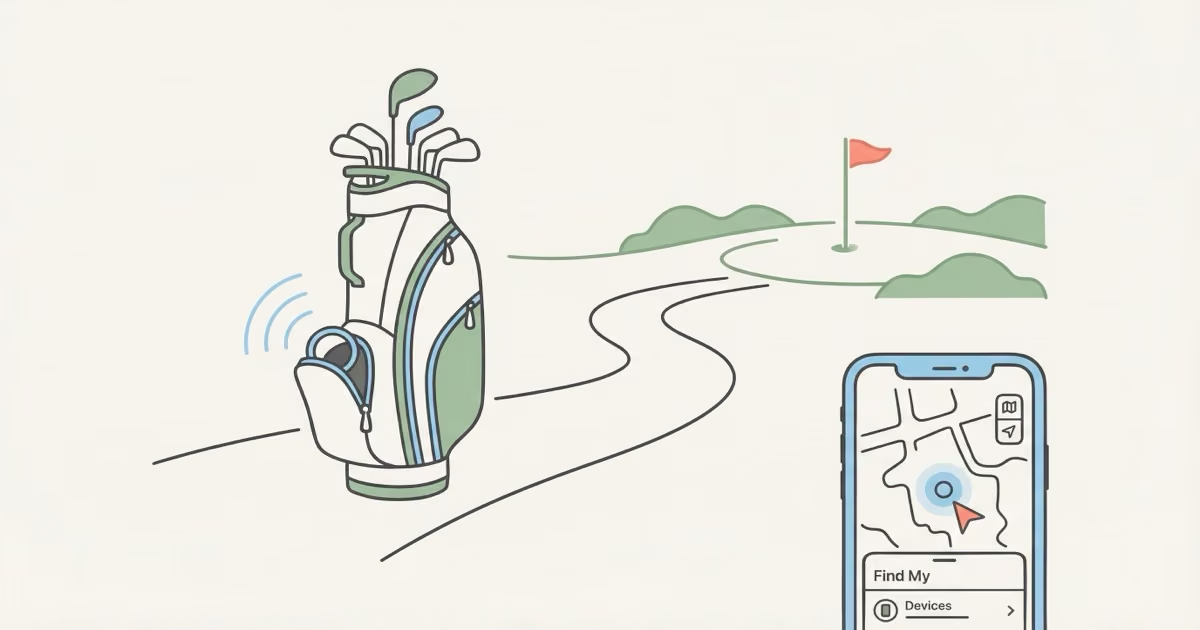
You can't put an AirTag inside a golf ball. The ball is entirely solid rubber and urethane with zero internal cavity. But AirTag is actually quite useful at the golf course for your bag, push cart, and travel case. The AirTag 2 extended Precision Finding to roughly 60 meters, which is far enough to guide you to your bag across a full parking lot.
Every golfer I know has had the same moment: you set the bag down on a cart path, walk twenty feet to read a putt, and come back to find it's been moved, or worse, it's gone. AirTag won't help you find the 7-iron you dunked in the water, but it can make sure the bag with your $1,800 set of irons doesn't disappear from the cart barn. This guide covers exactly how to use one on the course, what it can't do, and why that's a different question than tracking a golf ball (spoiler: that's a whole separate article).
- You cannot put an AirTag in a golf ball — the ball is solid rubber and urethane with no internal cavity, and driver impact forces exceed 3,400 Newtons.
- AirTag 2's Precision Finding range extends to ~60 meters, enough to locate your bag across an entire parking lot with a directional arrow.
- Over $100 million worth of golf equipment is stolen in the US each year; an AirTag in an inside zippered pocket is the lowest-cost deterrent available.
- For travel, AirTag is permitted in checked baggage and gives you exact bag location if an airline misroutes your clubs before you leave the terminal.
- Rural or private courses with sparse iPhone foot traffic may see location gaps of 20–30 minutes; a cellular GPS tracker is a better fit for real-time cart monitoring.
Can you put an AirTag in a golf ball?
No. Golf balls are solid all the way through. A two-piece ball is a dense rubber core pressed inside a hard Surlyn cover. A three-piece adds a urethane cover and a rubber mantle layer on top of that. There's no hollow center. No cavity. No space for anything.
An AirTag measures 31.9 mm wide and 8 mm thick. A regulation ball is 42.67 mm in diameter. On paper the numbers look close enough, but you'd need to hollow out the core entirely to fit the AirTag, at which point the ball is structurally destroyed and wildly illegal under USGA rules. And even if you somehow managed it, the impact forces on a driver swing exceed 3,400 Newtons. The CR2032 battery and UWB chip inside an AirTag aren't built for that.
If your actual goal is tracking a ball in the rough, GPS golf ball trackers like the Chippo or Garmin Approach Tag take a completely different approach. I'd send you there rather than waste your time. This article is about protecting your gear on the course, which AirTag handles well.
What AirTag Actually Does for Golfers
AirTag has no GPS chip. It relies on the Find My network: every nearby iPhone running iOS 14.5 or later acts as a silent relay, pinging your AirTag and passing its encrypted location to Apple's servers. On a busy public course packed with golfers carrying iPhones, location updates can be near-instant. On a remote private course in a rural area, updates might come every 20-30 minutes. That context matters for how you use it.
What AirTag does well: it tells you where your bag was last seen, plays a loud tone so you can hear it from across a room, and with AirTag 2's Precision Finding, guides you directly to it with an on-screen arrow and haptic pulses from up to about 60 meters away. That's far enough to work from one end of a parking lot to the other. The 60-meter Precision Finding range is four times what the original AirTag managed, which is a real upgrade if you've ever watched the old one show "nearby" while you were still 40 feet away.
What it won't do: track a ball in real time, work where there are no iPhones nearby, or pinpoint something moving fast. For a stationary bag in a cart barn or parking structure, it's close to ideal. For a cart rolling across the course, it's a poor fit; a cellular GPS tracker handles that better. See how accurate AirTags are for a full breakdown of the signal mechanics.
Protecting Your Golf Bag from Theft
Golf clubs are stolen more often than most golfers realize. Over $100 million worth of golf equipment is stolen each year in the US alone, according to security researcher data compiled by Tracki. Bags get taken from cart barns, parking lots, car trunks, and even bag drops during busy weekend rounds.
In 2023, the general manager of Briarwood Golf Club in Phoenix used AirTags to track a batch of stolen bags (12 sets in total) to a south Phoenix neighborhood and then to a nearby casino. Police arrested two people on felony charges, as Arizona's ABC15 reported. It's the kind of recovery that doesn't happen without a tracker in the bag. When the clubs are gone and you're trying to describe them to an officer, having a real-time location to hand over changes the entire conversation.
For placement, tuck the AirTag into a small zippered pocket inside the bag, not an external pocket that's visible and easy to grab. Silicone loops that hold the AirTag flush against the bag's inner wall work well. Keep it away from the bottom of the bag where it gets surrounded by metal shafts, because that much metal close to the antenna drops Bluetooth range significantly. A quality AirTag holder makes a real difference here.
One thing I appreciate about AirTag 2: if someone moves your bag without you, your iPhone sends an Unknown Item Detected alert. That notification can show up within minutes on a busy course. By the time most thieves have driven a mile, you've already got a location to share with staff or police.
Push Cart and Electric Cart
Push carts and electric trolleys have a theft problem of their own. They get left at bag drops, forgotten in storage areas between rounds, and occasionally borrowed by staff who aren't sure who it belongs to. An AirTag zip-tied to the frame costs nothing extra if you already own one.
Metal frames are the one catch. If the AirTag is sandwiched between two metal bars or sitting in a steel cup holder, signal range drops hard. Mount it on the outside edge of the frame, facing the sky rather than buried in the chassis. A TagVault Clip from Elevation Lab clips onto any bar and locks the AirTag in with a push, rated IP69K if someone ever pressure-washes the cart. That's the mount I'd use on a metal push cart.
For electric fleet carts at a club, an AirTag under the seat lets staff locate it quickly when it ends up in the wrong bay. AirTag 2's speaker is 50% louder than the original, so a starter can trigger a tone from the Find My app and hear it from across a noisy cart barn. That's a surprisingly practical feature at busy clubs on weekend mornings.
Travel Bag and Flight Tracking
This is where AirTag earns its keep for serious golfers. Airlines lose or misroute checked sports equipment constantly, and a full travel bag with a set of clubs, extra shafts, and a travel iron or two represents $2,000 or more of gear.
An AirTag in your travel case won't stop an airline from misrouting it, but it tells you exactly where the bag is. One traveler writing for Golf.com described arriving in Scotland for a trip and watching their AirTag show the bag was still sitting in Atlanta. That information (specific, immediate, actionable) is far more useful than "your bag may be delayed." You can file a formal misdirection claim with a specific location while you're still at the airport counter. Airlines can't require you to remove an AirTag from checked luggage. It's a consumer tracking device, not a prohibited item. The FAA has no restriction on it.
For international travel, coverage depends on iPhone density at your destination. Major European and Asian cities are well covered. Rural courses in developing markets may have gaps. The full country-by-country picture is in the international AirTag coverage guide. For the specific rules around what airlines can and can't do, AirTag in checked luggage covers it.
AirTag 2 Upgrades That Matter on the Course
| Feature | AirTag (Gen 1) | AirTag 2 (2026) | Why it matters for golf |
|---|---|---|---|
| Precision Finding range | ~15 m | ~60 m | Guides you to your bag across a full parking lot |
| Non-owner Precision Finding | No | Yes | Staff or a ranger can locate your bag without your Apple ID |
| Speaker volume | Baseline | +50% louder | Audible in noisy cart barns and bag drop areas |
| IP rating | IP67 | IP67 | Handles rain rounds and sprinkler hits without issue |
| Battery | ~1 year CR2032 | ~1 year CR2032 | One battery lasts a full season of weekly rounds |
The non-owner Precision Finding addition is underrated. With the original AirTag, only the person who registered it could use arrow-guided navigation. Now any iPhone 15 or later can navigate directly to an AirTag even without owning it, meaning a starter, caddie master, or ranger can physically guide themselves to your bag using the arrow UI, not just approximate map dots. Apple confirmed this in the AirTag 2 announcement.
Apple AirTag 2 — Recommended for Golf Bag and Cart Protection
- 60-meter Precision Finding with on-screen arrow
- Find My network: 2 billion+ Apple devices worldwide
- IP67 water and dust resistance
- ~1 year battery life on a single CR2032
- Non-owner Precision Finding (new in Gen 2)
Best Mounts for Golf Use
A bare AirTag rattling loose in a pocket works, but it's not ideal. Here are the mounts that make sense for golf-specific use cases.
| Mount | Best for | Key feature | Price range |
|---|---|---|---|
| Silicone sport loop | Bag strap or handle | Stretchy, water-resistant, low profile | $5-10 |
| Elevation Lab TagVault Clip | Push cart frame | Locking steel clip, IP69K rated | ~$18 |
| TagVault Surface (adhesive) | Under a cart seat or inside bag pocket | 3M adhesive pad, hidden install | ~$18 |
| Velcro pouch | Travel case or range bag | No tools needed, repositionable | $3-8 |
Skip the cheap plastic keyring-style holders for cart use. They're fine inside a bag pocket, but one bump on a rough path and the clip gives out. The TagVault Clip requires a deliberate push to release the AirTag. It's not coming off a cart frame by accident. For the full accessory breakdown beyond golf, see best AirTag holders and accessories.
Where AirTag Falls Short on the Course
Be realistic about what you're buying. AirTag has two meaningful limitations that matter in a golf context.
No real-time cart tracking. If you want to track a cart actively moving around the course, AirTag isn't the right tool. It updates when an iPhone is nearby. Between holes on a course with light foot traffic, that might mean 15-minute gaps. A cellular GPS tracker with a monthly data plan handles live tracking. For a direct comparison of the two approaches, best uses for AirTag maps out when each fits. And if you're wondering about using AirTag on a vehicle more broadly, the AirTag for car guide applies the same logic.
Rural courses have weaker coverage. The Find My network depends on iPhone density. A weekend-packed muni in a metro area will update fast. A remote resort course with thin foot traffic and few iPhones around will give you coarser, less frequent updates. That doesn't mean AirTag is useless there. The last-known location and audible tone still help. Just don't expect live tracking in a place where there are no iPhones to relay the signal.
The Bottom Line
Buy an AirTag for your golf bag. It's $29, takes five minutes to set up, and the one time your bag disappears you'll be glad you have it. The Briarwood Golf Club story (12 sets recovered, two arrests) is the argument in a single anecdote. Place it in an inside pocket away from metal shafts, grab a TagVault Clip if you're mounting it on a push cart, and check the battery every spring. That's the whole routine.
Don't buy it expecting to find your drives in the rough. That's a different problem requiring a different tool. For the golf ball tracker options that actually exist, the GPS golf ball article covers what's out there, though I'll warn you, none of them work quite like golfers wish they did either.
For a full review of the tracker itself before you commit, the AirTag 2 review has the hands-on detail.
FAQ
Can you put an AirTag in a golf ball?
No. Golf balls are solid all the way through, with no internal cavity. An AirTag is 31.9 mm wide and 8 mm thick; fitting it inside a 42.67 mm ball would require hollowing out the core and destroying the ball's structure. Even if that were possible, driver impact forces exceed 3,400 Newtons, which would wreck the electronics immediately.
Where should I put an AirTag in my golf bag?
Inside a small zippered accessory pocket, away from the metal club shafts. Metal degrades Bluetooth range, so depth in the main compartment surrounded by clubs is a bad spot. A loop on the outside strap or an adhesive mount on the inner bag wall both work better. Hide it well enough that a thief grabbing the bag quickly won't see it and pull it out.
Can I track my golf bag on a flight?
Yes, and it works well. AirTag is permitted in checked baggage; the FAA has no restriction on it. You won't get updates mid-flight, but once the bag is within range of any iPhone on the ground you'll see its location. Most major airports update within a few minutes of landing. If the bag is misrouted, you'll see exactly where it went before you even leave the terminal.
Is AirTag waterproof enough for golf?
IP67 rated, so it can handle up to 1 meter of water for 30 minutes. A rain round, a sprinkler hit, or a muddy cart path isn't going to hurt it. Don't drop it in a water hazard and leave it there, but normal golf weather is fine.
Can course staff use Precision Finding to locate my bag if I leave it behind?
With AirTag 2, yes. Non-owner Precision Finding is new in Gen 2: anyone with an iPhone 15 or later can navigate directly to an AirTag without owning it. A starter or caddie master can pull up the on-screen arrow and walk straight to your bag, not just look at an approximate dot on a map.
Does AirTag work at remote or rural golf courses?
Less reliably. Location updates depend on iPhones passing nearby. The Find My network has no independent coverage. A busy public course with weekend crowds will update frequently. A remote private club with sparse foot traffic may give you gaps of 20-30 minutes or longer. In those situations, the audible tone and last-known location are your main tools. A cellular GPS tracker is a better fit if live tracking on a remote course is your priority.
Do I need one AirTag or four for golf?
One is usually enough. Put it in your bag and that covers your clubs, bag, and everything in it. If you also want to track a push cart separately, grab a second. The 4-pack makes sense if you're tagging your bag, travel case, golf cart, and something else entirely, like your car in the course parking lot.