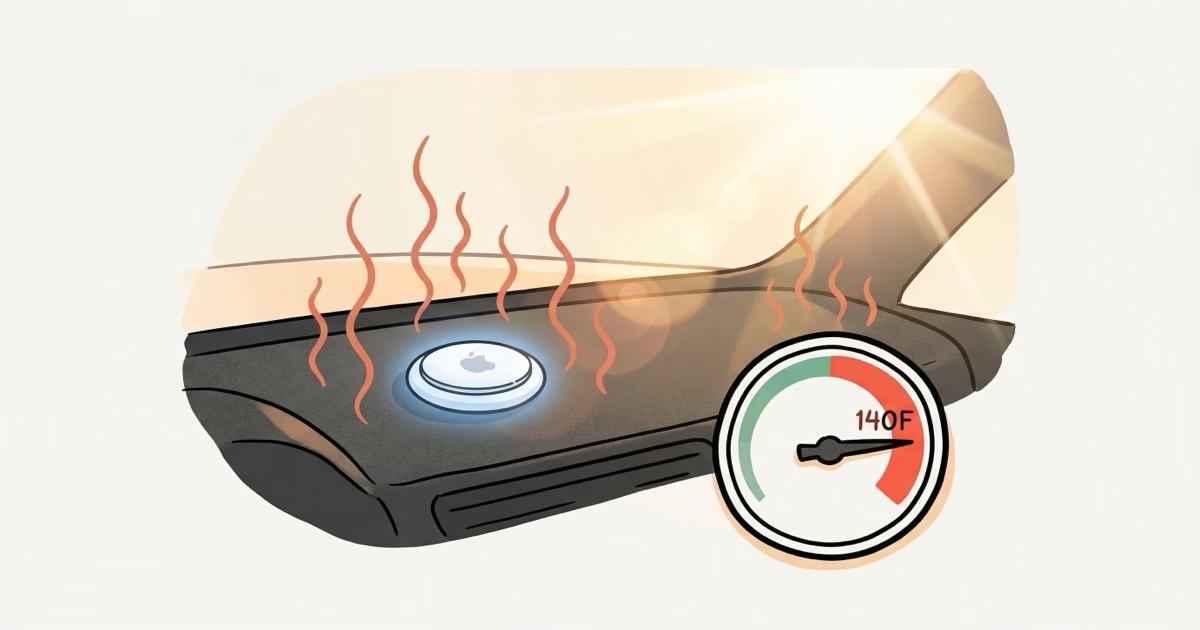
If you hide an AirTag in a car, heat is the thing that will eventually cause problems. Not water, not signal range, not battery life under normal conditions. Heat. The tracker sits in an enclosed metal box that routinely exceeds its rated temperature on summer afternoons, and there's no warning when it happens.
Apple's Official Temperature Rating
Apple's AirTag 2 spec page lists an operating ambient temperature of -4°F to 140°F (-20°C to 60°C). AirTag 1 has the same rating. These limits come directly from the CR2032 lithium coin cell battery inside, not the electronics. The chip and Bluetooth radio can handle more heat than the battery can.
The operating range is the temperature at which Apple guarantees normal function. Above 140°F, the AirTag enters thermal protection mode: Bluetooth shuts off, Find My updates stop, and the tracker goes invisible to your iPhone. It's not dead. It's protecting itself. Once the temperature drops back below the threshold, it typically resumes within minutes.
Some sources cite 113°F (45°C) as the limit. That was never Apple's published number. The actual ceiling is 140°F.
How Hot Cars Actually Get
A parked car in direct sun is a different world from the air temperature outside. A 2005 study in Pediatrics found that 80% of a car's interior temperature rise happens in the first 30 minutes. Cracking the windows barely helped, reducing temps by only 2-5°F.
| Location in Car | Temp at 100°F Ambient | AirTag Safe? |
|---|---|---|
| Dashboard (direct sun) | 157-200°F (69-93°C) | No, far exceeds limit |
| Steering wheel | 127°F (53°C) | No, above operating range |
| Seat surface (direct sun) | 123°F (51°C) | No, above operating range |
| Under seat (shaded) | 105-120°F (41-49°C) | Borderline, within rated range |
| Trunk | 95-115°F (35-46°C) | Generally safe |
These numbers come from Arizona State University research testing vehicles in Tempe, AZ during summer. At 110-115°F ambient (a normal Phoenix July afternoon), dashboards exceeded 180°F. Even at a mild 72°F outside, cabin air reached 117°F within an hour. Dark-colored cars ran 10°F+ hotter inside than light-colored ones. Using a reflective windshield sunshade dropped dashboard temps by 15-25°F, which is enough to keep under-seat positions within the AirTag's rated range in most climates.
So if you're hiding an AirTag in a car for theft tracking, the best places to hide an AirTag in a car are the positions that stay coolest. Dashboard and glove box are out. Under the seat and spare tire well are in.
What Happens When AirTag Overheats
The failure mode depends on how far above the limit and for how long:
- 140-160°F (60-71°C): Thermal protection kicks in. Bluetooth stops. The AirTag shows its last known location in Find My with a stale timestamp. When it cools, it comes back online. No permanent damage from a single event at this range.
- 160-180°F (71-82°C): Approaching dashboard-in-direct-sun territory. Battery capacity takes permanent hits. Repeated exposure here is where the CR2032 starts losing months of life. In rare cases the battery can swell slightly, making the back cover harder to twist off.
- Above 180°F (82°C+): Sustained exposure at extreme dashboard temps. The polycarbonate shell can soften. Battery electrolyte breakdown accelerates. This is permanent damage territory, though catastrophic failure reports are rare because most people don't leave AirTags on dashboards.
The lack of catastrophic failure reports on Reddit and Apple forums is actually informative. Most people don't leave AirTags on dashboards, and when heat does cause issues, it shows up as "my AirTag stopped updating for a few hours" rather than "my AirTag died." The silent problem is battery drain. You don't notice until the AirTag dies at month 7 instead of month 12.
If your AirTag stopped updating after a hot day, check whether it shows as location not updating in Find My. That's the thermal protection signature. Give it an hour to cool and check again. If it still won't connect after cooling, the AirTag not working troubleshooter covers reset steps.
The Battery Problem Nobody Talks About
Most people worry about the AirTag going dark on a hot afternoon. That's temporary. The bigger problem is the battery dying three months early, and you don't find out until the tracker is already dead.
Data from Battery University's lithium degradation research shows the scale of the problem:
- At 77°F (25°C): battery retains 96% capacity after one year
- At 104°F (40°C): drops to 85% after one year
- At 140°F (60°C): drops to 75% after one year, and at full charge, 60% capacity loss in just three months
That last number matters. An AirTag sitting in a hot car all summer, fully charged CR2032 inside, loses over half its battery capacity by fall. The AirTag battery life guide assumes normal conditions (about a year per CR2032). In a hot car, expect 6-8 months instead. Replace the battery before each summer if you're using AirTag for car tracking.
AirTag vs Other Trackers on Heat
Most Bluetooth trackers share similar thermal constraints because they all run on CR2032 batteries. But the rated ranges vary more than you'd expect:
| Tracker | Operating Temp Range | Battery |
|---|---|---|
| Apple AirTag / AirTag 2 | -4°F to 140°F (-20 to 60°C) | CR2032 (replaceable) |
| Tile Pro / Tile Mate | -4°F to 140°F (-20 to 60°C) | CR2032 (replaceable) |
| Samsung SmartTag 2 | 32°F to 104°F (0 to 40°C) | CR2032 (replaceable) |
| Chipolo ONE Point | 14°F to 113°F (-10 to 45°C) | CR2032 (replaceable) |
AirTag and Tile are tied for the widest heat tolerance. Samsung SmartTag 2 is the most heat-sensitive at just 104°F (40°C), which means it would shut down in any parked car on a warm day, even in Seattle. Chipolo's 113°F ceiling puts it in an awkward spot: fine for pockets and bags, but marginal for any car that sits in direct sun for more than 30 minutes.
Cellular GPS trackers like Tracki and Bouncie use lithium-ion packs designed for wider thermal ranges and generally handle car environments better. They also give you real-time location without depending on nearby iPhones. But they cost $5-15/month in subscriptions and need recharging every 1-3 weeks. For most people who just want a passive theft recovery tool in the car, an AirTag mounted in a cool spot is the better trade. You pay $29 once and swap a $3 battery once a year. Hard to argue with that.
AirTag 2: Any Heat Improvement?
No. Apple kept the same -4°F to 140°F operating range for AirTag 2. The upgrades were a second-generation UWB chip (better Precision Finding range), a louder speaker, and updated anti-stalking features. Nothing about thermal management, shell material, or battery chemistry changed.
This isn't surprising. The temperature ceiling is set by the CR2032 battery chemistry, not the electronics. Apple would need to switch battery formats to change the thermal spec, and that would mean changing the entire physical design. Every CR2032-based tracker faces the same ceiling. For details on what Precision Finding range actually looks like, how accurate AirTags are breaks down the UWB vs. Bluetooth tradeoffs.
Protecting Your AirTag from Heat
- Never mount on the dashboard. It's the hottest surface in any car. Even on an 80°F day, a dashboard in direct sun can hit 130°F+.
- Best spots: under seat or spare tire well. These stay 30-50°F cooler than the dashboard. The spare tire well in the trunk is the coolest location in most vehicles.
- Use a windshield sunshade. Reduces dashboard temperature by 15-25°F and lowers overall cabin temp. Helps every device in the car, not just the AirTag.
- Replace the battery before summer. A fresh CR2032 handles heat stress better than one that's already six months old. If your AirTag lives in a hot-climate car year-round, swap the battery every 6-8 months instead of waiting for the low-battery warning.
- Skip the metal holders. Metal conducts heat. A bare AirTag or one in a silicone case stays marginally cooler than one in an aluminum mount on a hot metal car frame.
Frequently Asked Questions
Can AirTag survive a full summer in a parked car?
Yes, if it's mounted in a shaded spot like under the seat or in the trunk. The AirTag itself will survive. The electronics are rated well beyond what a car interior reaches. The battery is the weak link. Expect to replace the CR2032 sooner than the usual 12 months. In hot climates (Phoenix, Dallas, Las Vegas), plan on 6-8 months per battery for a car-mounted AirTag.
Will a single hot day permanently damage my AirTag?
Unlikely. A single day at typical car temperatures (under 160°F in a shaded position) causes temporary shutdown but no permanent damage. The AirTag recovers when cooled. Permanent damage comes from repeated exposure over weeks or months, mostly to the battery, not the tracker itself.
Does AirTag warn you when it's overheating?
No. AirTag has no temperature sensor and sends no thermal alert. The only sign is that it stops updating in Find My. You'll see the last known location with a stale timestamp. If that happens on a hot day, heat is the most likely cause. Wait for it to cool and check again.
Is AirTag safe in a dryer or dishwasher?
No. AirTag is IP67-rated for water (1 meter, 30 minutes), but that rating doesn't cover heat. A clothes dryer runs at 125-135°F, within the rated limit on paper but with sustained hot airflow and tumbling. A dishwasher's heated dry cycle hits 150-170°F, well past the limit. A sauna runs at 150-190°F. None of these are safe. Check pockets before doing laundry. If you accidentally ran an AirTag through the dryer, test it in Find My afterward. It might still work, but expect the battery to need replacing sooner.
Does heat affect Precision Finding?
If the AirTag is in thermal protection mode, all radios are off. No Bluetooth, no UWB, no Precision Finding. The directional arrow feature only works when the AirTag is powered on and within about 30-45 feet of a compatible iPhone. Once the AirTag cools and resumes, Precision Finding works normally again.
Should I worry about AirTag heat in the UK or Canada?
Less so. The UK rarely sees ambient temps above 90°F (32°C), and car interiors in mild climates typically peak around 115°F in direct sun. That's within the AirTag's rated range. Canadian summers in southern Ontario and BC can push car interiors higher, but nothing like the American Southwest. Keeping the AirTag off the dashboard is still good practice everywhere. The real heat-risk regions are the US Sun Belt (Arizona, Texas, Nevada, Florida), the Middle East, Australia, and parts of South Asia where ambient temps regularly exceed 100°F.
Which tracker handles car heat best?
AirTag and Tile Pro are tied at 140°F (60°C) for the highest CR2032-based rating. Samsung SmartTag 2 is the worst at just 104°F. For truly harsh environments, a cellular GPS tracker with a lithium-ion battery (like Tracki or Bouncie) handles heat better, but comes with a monthly subscription.
The Bottom Line
AirTag is rated to 140°F (60°C), which covers most real-world situations except one: a car parked in direct sun during a hot summer. The tracker won't die from an occasional hot day. But if it lives in a car year-round, the battery pays for every heat cycle. Mount it under the seat or in the trunk, swap the CR2032 before each summer, and use a windshield sunshade. That combination keeps it working year-round in almost any climate. At $29 for the tracker and $3 for a replacement battery, the maintenance cost is trivial compared to replacing a stolen car.