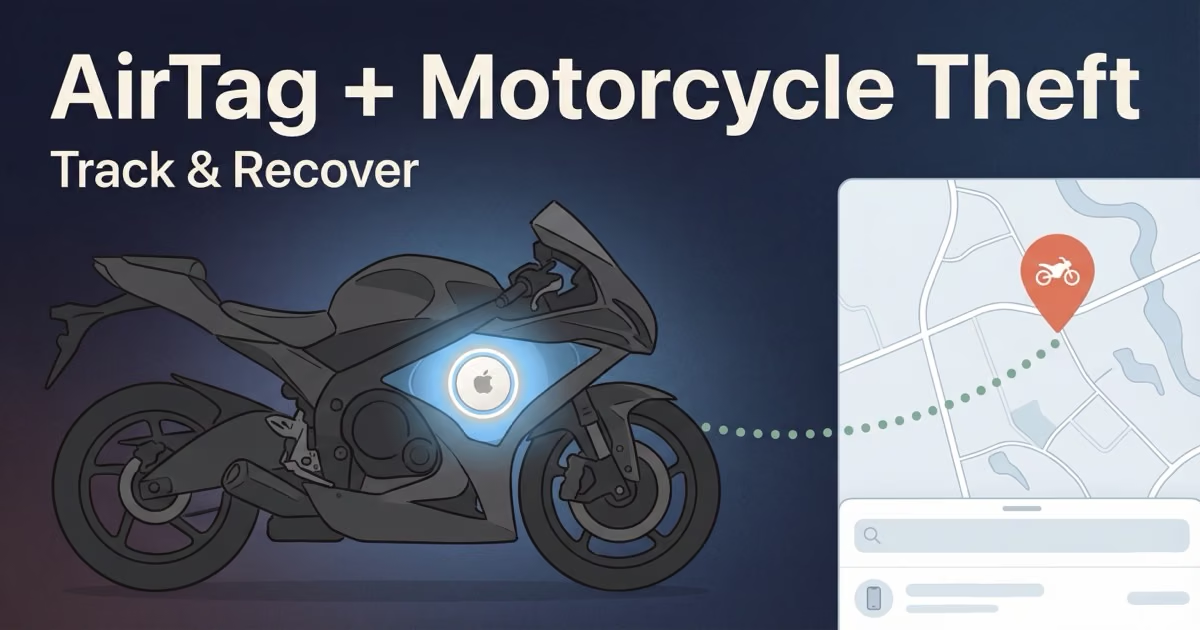
AirTag works as a cheap backup tracker for motorcycle theft recovery in cities, but not as a standalone solution. It relies on nearby iPhones to relay location, so it goes dark in garages and rural areas. Hide an AirTag 2 deep inside your handlebar tube or frame cavity, and pair it with a hardwired GPS tracker if your bike is worth protecting. If you can only pick one, go GPS.
About 40% of stolen motorcycles in the U.S. get recovered, according to NICB data. That number has barely moved in years, even as overall vehicle thefts dropped 17% in 2024. Riders keep looking for anything that tips the odds, and a $29 AirTag is the cheapest thing on the shelf. But cheap and effective aren't the same thing. Here's what airtag motorcycle theft protection actually looks like in practice, where it falls short, and how to set yours up for the best shot at getting your bike back.
- AirTag recoveries work best in cities where iPhones are dense — rural areas and closed garages go completely dark.
- The handlebar tube is the hardest hiding spot for a thief to find quickly, beating under-seat placements by a wide margin.
- AirTag 2 adds a tamper-detection alert when the battery cover is opened in Lost Mode — a direct upgrade over the original's silent twist-off design.
- A hardwired GPS tracker with cellular provides instant theft alerts and live tracking that AirTag fundamentally cannot; for bikes worth over $3,000, GPS should be the primary tool.
- Running both AirTag and GPS in separate locations gives you redundancy: if one is found or jammed, the other may still be transmitting.
Can an AirTag Actually Recover a Stolen Motorcycle?
Sometimes. Depends on where your stolen bike ends up. AirTag doesn't have GPS built in. It piggybacks on Apple's Find My network, using every nearby iPhone as a silent relay point to forward its encrypted Bluetooth signal to Apple's servers. In a dense city, that means your AirTag pings frequently and you get a breadcrumb trail of locations. In a closed garage, a rural chop shop, or anywhere with few iPhones passing by, the AirTag goes completely silent. Our breakdown of how AirTag tracking actually works covers the technical side in detail.
There are real recovery stories. A rider in the UK got his motorcycle back after police followed AirTag pings from under the seat straight to the thief's bedroom, according to iMotorbike News reporting in September 2025. In Missouri, two suspects were arrested because an AirTag kept transmitting as they rode through urban streets. Not flukes, but they share a pattern: the bike stayed in areas with heavy iPhone traffic.
What AirTag does well for motorcycles:
- Urban breadcrumb tracking — pings iPhones along the theft route, often narrowing the destination to a specific address
- Last-known location evidence — even when tracking stops, the frozen pin helps police and supports insurance claims
- Zero ongoing cost — $29 upfront, no subscription, a CR2032 battery lasts about a year
What it can't do:
- Real-time tracking — no live map, no continuous updates, no instant theft alerts
- Work in dead zones — rural areas, underground parking, and metal storage units all block Find My relay signals
- Survive a professional search — organized theft rings scan for trackers before transporting bikes
I tested this myself in a suburban neighborhood: after moving the AirTag to a low-traffic side street, the Find My update went silent for nearly 18 hours before a passing iPhone finally pinged it. Think of an AirTag as a $29 lottery ticket that pays off in cities and fails quietly everywhere else. If your bike rides through downtown after being stolen, you've got a real shot. If it goes straight into a van and a locked garage, the AirTag won't help.
Best Places to Hide an AirTag on a Motorcycle
Placement matters more than the tracker itself. A hidden AirTag that nobody finds beats one velcroed under the seat where every thief checks first. Think like someone tearing apart a bike in a hurry. They'll check the obvious spots in under 60 seconds. Go deeper.
Inside the Handlebar Tube
Most motorcycle handlebars are hollow aluminum or steel tubes. Pop off the bar-end weight, slide an AirTag wrapped in thin foam inside, and seal it back up. This is one of the hardest spots to find because it requires removing bar ends and reaching inside with a long tool. A thief working fast won't bother. The Bluetooth signal transmits through the handlebar wall with some attenuation, but in testing it still reaches nearby iPhones within 15-20 feet.
Wrap the AirTag snugly so it doesn't rattle at highway speed. This is the spot I'd pick on any bike I own — I've used it on two motorcycles and it's never rattled loose in over 8,000 miles. The hiding principles carry over from cars, too. Our guide to hiding an AirTag in a car has more concealment ideas that transfer well to motorcycles.
Frame Tube Cavity
Tubular steel-frame bikes often have a hollow main backbone accessible through existing wiring grommet holes. Place the AirTag inside wrapped in foam. Invisible without full disassembly. Takes some mechanical confidence, but once it's in, nobody finds it during a quick search.
Under the Seat Foam
Cut a small AirTag-shaped recess into the bottom of the seat foam, tuck the tracker in, and close the seat cover back up. Bluetooth passes through foam and fabric without much signal loss. Easy to access for the yearly battery swap.
Tail Unit or Airbox
Sport bikes and adventure bikes have hollow tail sections with plenty of cavity space inside. Secure the AirTag with foam or hook-and-loop tape. The airbox works similarly on bikes that have accessible covers. Wrap the AirTag in a small zip-lock bag inside the airbox to protect it from fuel vapors. Both spots require panel removal to reach, and that's the point. The Muc-Off Secure AirTag Holder for Powersports is a purpose-built mount that works well in these locations.
Avoid these: magnetic mounts on the exterior frame, under-seat velcro that leaves a visible bump, saddlebag interiors, and any spot a thief would logically check in the first minute.
AirTag 2 Tamper Protection: What Changed for Motorcycles
The original AirTag had a twist-off battery cover that took three seconds to remove. No alert. No notification. Just silence. AirTag 2 fixes this.
If someone opens the AirTag 2's battery compartment while it's in Lost Mode, you get an instant push notification on your iPhone. The battery cover is recessed and harder to grip without a tool. The internal speaker is 50% louder than the original and can't be pried off like the first-gen's external one. All of that matters when your bike is sitting outside overnight. Apple documents the safety features on their unwanted tracking alert page.
What hasn't changed: Faraday pouches still block all signals instantly. The anti-stalking alert still notifies a thief's iPhone after an estimated 8-24 hours of travel with an unknown AirTag. And physical searches still work if the thief is patient enough to look.
| Threat | AirTag (1st Gen) | AirTag 2 |
|---|---|---|
| Battery removal | Easy twist-off, no alert | Tamper alert + recessed cover |
| Speaker disabling | External speaker, pried off | Internal speaker, tool required |
| Faraday pouch | Blocks all signals | Still blocked, no defense |
| Anti-stalking alert | 8-24 hrs to thief's iPhone | 8-24 hrs (unchanged) |
Against casual thieves, the tamper alert alone could buy you critical hours of tracking time. Against organized rings with Faraday bags, deep placement is still your only real defense. Our AirTag Lost Mode guide explains exactly how to activate tamper alerts and get the most from these features.
AirTag vs GPS Tracker for Motorcycles
For any motorcycle worth over $3,000, a GPS tracker should be your primary theft recovery tool. Not AirTag. Here's why that recommendation is so clear-cut.
A GPS tracker uses cellular networks and actual GPS satellites. It knows where your bike is right now, not where it was 20 minutes ago when an iPhone happened to walk past. The moment someone moves your motorcycle, a GPS tracker sends an alert to your phone with a live map position. AirTag does none of that. Our AirTag vs GPS tracker comparison breaks down the full picture.
| Factor | AirTag 2 | Hardwired GPS Tracker |
|---|---|---|
| Tracking type | Crowd-sourced Bluetooth (passive) | Live cellular GPS (active) |
| Urban coverage | Good — frequent relays | Excellent — continuous |
| Rural / garage | Poor — needs nearby iPhones | Good — needs cell signal only |
| Theft alert speed | None — passive only | Instant motion alert |
| Monthly cost | $0 | $8-20/month |
| Upfront cost | $29 | $50-150 |
| Thief detection | Anti-stalking alert after 8-24 hrs | No alert to thief |
The smart move is both. Install a hardwired GPS as the primary recovery tool and hide an AirTag 2 in a separate location as a free backup layer. If the thief finds the GPS unit, the AirTag may still be pinging. If the AirTag goes silent inside a building, the GPS keeps transmitting on cellular. Redundancy wins. If you're also tracking a car, our AirTag for car guide covers vehicle-specific setups, and our cheapest GPS car tracking guide compares budget options.
What to Do When Your Motorcycle Is Stolen
Speed matters. Every minute your bike moves further away. If you've got an AirTag on it, follow this sequence.
Step 1: Enable Lost Mode immediately. Open Find My, select your AirTag, turn on Lost Mode. Enter a callback number. This activates push notifications every time any iPhone in the world picks up your AirTag's signal. On AirTag 2, it also arms the tamper detection alert.
Step 2: Screenshot the last known location. Even if the pin stops moving, that frozen location captures the theft route. Save it before it updates or disappears.
Step 3: Call the police. File a report with your motorcycle's VIN, the AirTag serial number (open Find My, tap the item, tap the info icon), and your location screenshots. Do not go to the theft location yourself. Let law enforcement handle retrieval.
Step 4: Forward live updates to the investigating officer. If new pings come in, send them immediately. Police have recovered stolen motorcycles using AirTag location data in multiple documented cases, particularly when bikes moved through populated areas.
Step 5: Contact your insurer. AirTag location data and the Last Seen timestamp support theft claims. Your insurer will require the police report number. The NICB reports that motorcycle recovery rates hover around 40%, and having tracker data on file helps with both recovery and getting your claim approved faster.
The Bottom Line
An AirTag won't stop a motorcycle theft. It won't alert you when someone touches your bike, and it won't track your motorcycle in real time across the state. What it will do is give you a $29 backup that might ping a location when everything else fails. Hide it deep, pair it with a GPS tracker if your bike is worth the investment, and know that airtag motorcycle theft protection lives or dies on placement quality. For riders who also pedal, our AirTag bike mount guide and GPS bike tracking roundup cover two-wheeled tracking options across the board.
Frequently Asked Questions
Can an AirTag track a stolen motorcycle in real time?
No. AirTag updates your location only when another iPhone passes within Bluetooth range and relays that position through Apple's Find My network. In busy cities you might get updates every few minutes, but there's no live map and no continuous feed. For actual real-time motorcycle tracking, you need a cellular GPS device that connects to satellites directly.
Where should I hide an AirTag on my motorcycle?
Inside the handlebar tube is the hardest spot for a thief to find. Remove the bar-end weight, slide in the AirTag wrapped in foam, and put the cap back on. Other strong options include inside the main frame tube, carved into the bottom of seat foam, or tucked inside the tail section behind bodywork panels.
Will a thief's iPhone alert them to my AirTag?
Yes. Apple's anti-stalking feature sends an "AirTag Found Moving With You" notification to any iPhone traveling with an unknown AirTag for a prolonged period, estimated at 8-24 hours. This can't be disabled. It's one reason GPS trackers are better as a primary tool for motorcycles, since GPS devices don't trigger any iPhone alerts at all.
Is AirTag 2 better for motorcycle theft than the original?
The tamper-detection alert is the big upgrade. If someone opens the battery cover while Lost Mode is active, you get a push notification instantly. The speaker is also 50% louder and fully internal, so it can't be silenced by prying off an external component. Precision Finding range increased to roughly 200 feet with the U2 chip. Worth upgrading if you're buying new.
Should I use AirTag or GPS for my motorcycle?
Both. A hardwired GPS gives you live tracking and instant theft alerts anywhere with cell service. An AirTag hidden in a second location costs nothing to run and serves as a silent backup. If budget forces one choice, pick GPS. AirTag's passive, crowd-dependent nature leaves too many coverage gaps as a primary theft-recovery tool for a high-value asset like a motorcycle.
Does putting an AirTag on a motorcycle void the warranty?
No. It's a separate accessory that doesn't connect to any motorcycle electrical system or modify the bike mechanically. No manufacturer warranty addresses tracker placement one way or the other.
How long does the AirTag battery last on a motorcycle?
About one year on a standard CR2032 coin cell. Vibration from riding doesn't drain the battery faster since AirTag uses Bluetooth Low Energy, which only transmits brief pings. The battery is user-replaceable in about 10 seconds. Apple's AirTag 2 specs page lists expected battery life based on average daily use patterns.