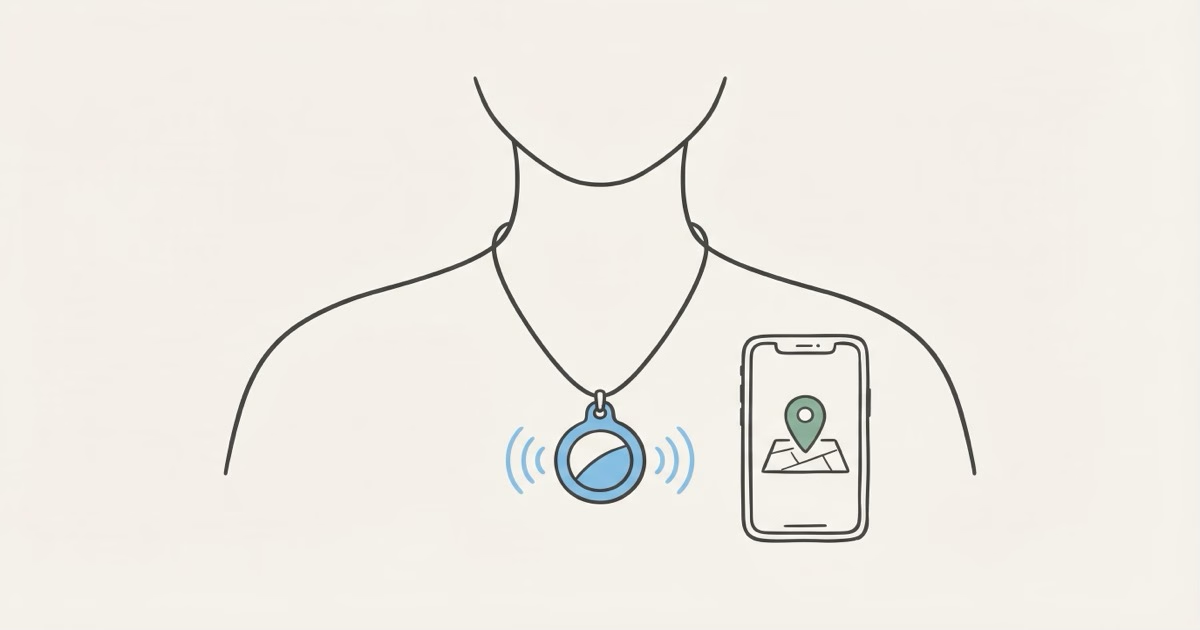
The AirTag wasn't designed to be worn. It's a disc meant for bags, keys, and wallets. But parents figured out pretty quickly that slipping one into a pendant holder and putting it around a kid's neck at Disney World gives them a location ping every time any iPhone walks by. Which, at a theme park, is basically continuous.
Apple doesn't make a necklace holder. The entire market is third-party. Some of these holders work well, some are junk, and there are real safety considerations most product listings don't mention. Here's what actually matters.
Who Wears an AirTag Necklace
Three groups buy these, and they're buying for very different reasons:
Parents tracking kids at crowded events. This is the biggest use case by far. Theme parks, airports, festivals, school field trips. A child wanders off, and instead of panicking for twenty minutes, you open Find My and see a location update from 90 seconds ago. At a place like Disney World where thousands of iPhones are constantly walking past, the AirTag gets pinged almost continuously. One parent on a Disney forum described losing all three kids at different times across a single trip and calling the necklace "the only thing that kept me sane."
Caregivers of elderly family members with dementia. Over half of people with Alzheimer's will wander at some point. An AirTag pendant gives a last-known location when someone can't communicate where they are. This isn't a medical alert device. It can't call 911 or detect a fall. But it does answer the question "where were they last seen?" which is often the most critical information in a wandering incident. Some specialized companies like MedicalIDFashions sell unremovable AirTag bracelets with clasps that require two hands to open, specifically designed for dementia patients who might otherwise take off a regular necklace.
Adults who want a wearable tracker while traveling. Less common, more niche. Some solo travelers wear an AirTag pendant in unfamiliar cities as a passive location breadcrumb. The best uses for AirTag guide covers this alongside other personal tracking scenarios.
Necklace Holder Options
The AirTag has no built-in necklace attachment. You need a holder with a bail (the small loop at the top that a chain or cord passes through). Three main types exist:
Silicone Pendant Cases ($8-15)
Soft, lightweight, and the most popular option. A flexible silicone shell wraps around the AirTag with a small metal or silicone bail on top. Total weight with AirTag: about 18-22g. Most come in packs of two or four. The dtylean holder is a typical example: TPU case with a 20-inch leather cord, marketed for kids. Battery access is easy. Pop the AirTag out, twist the back, swap the CR2032, snap it back in.
The tradeoff: thin silicone can stretch over months, especially in heat. If one fails, you have spares from the multi-pack. For more AirTag holder options beyond necklaces, the holders and accessories roundup covers every form factor.
Metal and Jewelry-Style Holders ($15-25)
Stainless steel or titanium alloy cases that look like actual jewelry. The DEERLET rhinestone holder is one of the more popular options: titanium alloy with cubic zirconia, twist-lock closure, 29-inch adjustable chain included. Total weight with AirTag runs 30-40g. These make more sense for adults who want something that doesn't scream "I'm wearing a tracker."
The heavier weight matters for small children. A 35g pendant is nothing for an adult but can feel heavy to a three-year-old after a few hours. For kids under five, stick with silicone. Etsy also has a growing market for handmade AirTag pendants, including personalized leather holders with a child's name and emergency phone number engraved. The engraving adds a practical backup: if someone finds the child and doesn't have a phone to scan the AirTag's NFC, the contact info is right there on the pendant.
Safety: The Breakaway Clasp Rule
Any necklace on a child needs a breakaway clasp. A fixed chain that catches on playground equipment, a car door, or a crib rail is a strangulation hazard. Breakaway clasps release under about 15 pounds of tension. The necklace snaps open before it can tighten around a neck.
This isn't theoretical. Pediatric safety organizations have documented strangulation incidents with children's necklaces and lanyards for decades. The same risk applies to AirTag necklaces.
Beyond the cord, there's the battery. The CPSC issued a Notice of Violation to Apple in January 2025 over inadequate battery ingestion warnings on AirTags. A swallowed CR2032 can cause internal chemical burns in as little as two hours. Apple now includes updated warning labels, but the responsibility falls on parents: make sure young children can't open the AirTag's battery compartment. Holders that fully enclose the AirTag (rather than leaving the back exposed) add a layer of protection.
The Anti-Stalking Alert Problem
Put an AirTag necklace on your child at a theme park, and here's what happens: any stranger's iPhone that stays near the AirTag for 8-24 hours will eventually get an "Unknown AirTag Traveling With You" alert. Apple's anti-stalking system can't tell the difference between a parent's tracker on their kid and a stalker's tracker on a victim.
In practice, this mostly causes confusion rather than real problems. The alert doesn't identify the AirTag's owner. If a stranger taps the notification, they'll see that the AirTag is registered to someone, but not your name or details.
To reduce false alerts: keep the AirTag under clothing rather than visible, and stay physically close to the child when possible. Your iPhone's proximity suppresses the alert for nearby phones. In iOS 17+, you can share AirTag access with up to five people through Family Sharing, which prevents alerts on those family members' iPhones entirely. The "found moving with you" guide explains the alert timing and how the system works from the other side.
AirTag Necklace vs. Dedicated Child Trackers
Purpose-built child trackers like AngelSense and Jiobit offer GPS, cellular, real-time location, geofencing alerts, and sometimes two-way audio. They cost $100-200 upfront plus $15-30/month. The AirTag 2 costs $29 once with no subscription.
| Feature | AirTag Necklace | Dedicated Child Tracker |
|---|---|---|
| Cost | $29 one-time + $8-15 holder | $100-200 + $15-30/month |
| Location Type | Crowdsourced (needs nearby iPhones) | GPS + cellular (works anywhere with signal) |
| Update Speed | Minutes in crowds, hours in quiet areas | Real-time continuous |
| Geofencing | No | Yes (alert when child leaves area) |
| SOS / Two-Way Audio | No | Some models, yes |
| Battery | 12+ months (CR2032) | 1-5 days (rechargeable) |
For a one-time event like a Disney trip, an AirTag necklace is a reasonable low-cost layer. For daily tracking of a child who goes to school, activities, and playdates, a cellular tracker with geofencing is the right tool. Some parents use both: AirTag as a passive backup that lasts a year without charging, and a dedicated tracker for real-time alerts during the school day. The AirTag alternatives guide compares tracker types for personal safety use cases.
Weight and Comfort for All-Day Wear
AirTag weighs 11g on its own (AirTag 2 is 11.8g). Add a holder and cord:
- Silicone case + fabric lanyard: 18-22g total. Barely noticeable for adults. Fine for kids over five.
- Metal case + chain: 30-40g total. Standard necklace weight for adults. Heavy for toddlers.
- Leather cord setup: 25-30g total. Good middle ground.
For children under five, go with the lightest option: silicone case on a thin elastic cord with a breakaway clasp. A shorter cord (14-16 inches for kids, 18-22 inches for adults) sits at chest height and reduces snagging risk. After a full day at a theme park, even a light pendant can annoy a tired four-year-old, so be prepared to pocket it.
AirTag 2 Compatibility
Every necklace holder made for the original AirTag fits AirTag 2. Apple kept the dimensions identical: 31.9mm diameter, 8.0mm thick. The 0.8g weight difference is imperceptible. Amazon listings that say "compatible with AirTag 1st and 2nd generation" are accurate. Apple's AirTag 2 spec page confirms the unchanged form factor.
AirTag 2 does improve findability when it matters most. Precision Finding range expanded from ~15m to ~60m, and the speaker is 50% louder, which helps when you're trying to locate a child in a noisy environment using Find My's "Play Sound" feature. The speaker is also glued to the housing now, making it harder to disable. If you're buying specifically for a child-tracking necklace, AirTag 2 is the better pick. The accuracy guide covers what those range improvements mean in practice.
Frequently Asked Questions
Is wearing an AirTag as a necklace safe for kids?
The AirTag itself is IP67-rated and non-toxic for skin contact. The risk is the cord: any fixed necklace can be a strangulation hazard on playground equipment. Always use a breakaway safety clasp that releases under about 15 pounds of tension. Also keep the AirTag's battery compartment inaccessible to young children. A swallowed CR2032 battery can cause serious injury.
Does Apple make an AirTag necklace?
No. Apple's AirTag accessories include the FineWoven Key Ring ($35) and previously the Polyurethane Loop ($29, discontinued). None are necklaces. The entire AirTag necklace market is third-party, sold on Amazon and Etsy.
How often does an AirTag necklace update location?
Every time an iPhone passes within Bluetooth range (~30 feet for AirTag 1, ~200 feet for AirTag 2). In a crowded theme park, that can mean updates every few minutes. In a quiet suburb, every few hours. There's no continuous GPS. The battery life guide covers how frequent pinging affects battery drain.
Will other people get stalking alerts from my child's AirTag?
Possibly. If another person's iPhone stays near the AirTag for 8-24 hours, they may get an "Unknown AirTag Traveling With You" alert. This is Apple's anti-stalking system. It can't distinguish between a parent's tracker and an unwanted one. Keep the AirTag under clothing and stay close to your child to reduce false alerts.
Can my child remove the AirTag necklace?
Yes. Any necklace can be taken off. For children who might remove it, pin-on holders that attach inside clothing (shirt collar, waistband) stay put better. Some caregivers for dementia patients use holders with clasps that require two hands to open, making removal harder without assistance.
Does wearing an AirTag all day drain the battery faster?
Not meaningfully. The AirTag broadcasts the same way whether it's moving or sitting still. Being in a crowd means more frequent pings, which uses marginally more power. Real-world difference: negligible. Battery still lasts 12+ months. The CR2032 costs about $3 to replace.
What's better for kids: necklace, wristband, or clothing clip?
Clothing clips (pinned inside a shirt or waistband) are the safest because they can't be seen, caught on equipment, or easily removed. Wristbands work for older kids who won't fidget with them. Necklaces are easy to put on and take off but carry strangulation risk without a breakaway clasp. For the AirTag's sound features, all placement options work equally well since the speaker isn't muffled by clothing.
The Bottom Line
An AirTag necklace is a $37 solution ($29 AirTag + $8 holder) that solves a specific problem: knowing where someone was last seen in a crowded place. It's not a replacement for an Apple Watch with Emergency SOS, a Garmin satellite communicator, or a dedicated GPS child tracker with geofencing. But for a Disney trip, a school field trip, or peace of mind with an elderly family member, it's a cheap layer of location awareness that works anywhere iPhones exist. Get a silicone holder, use a breakaway clasp, and keep the battery compartment away from small hands.