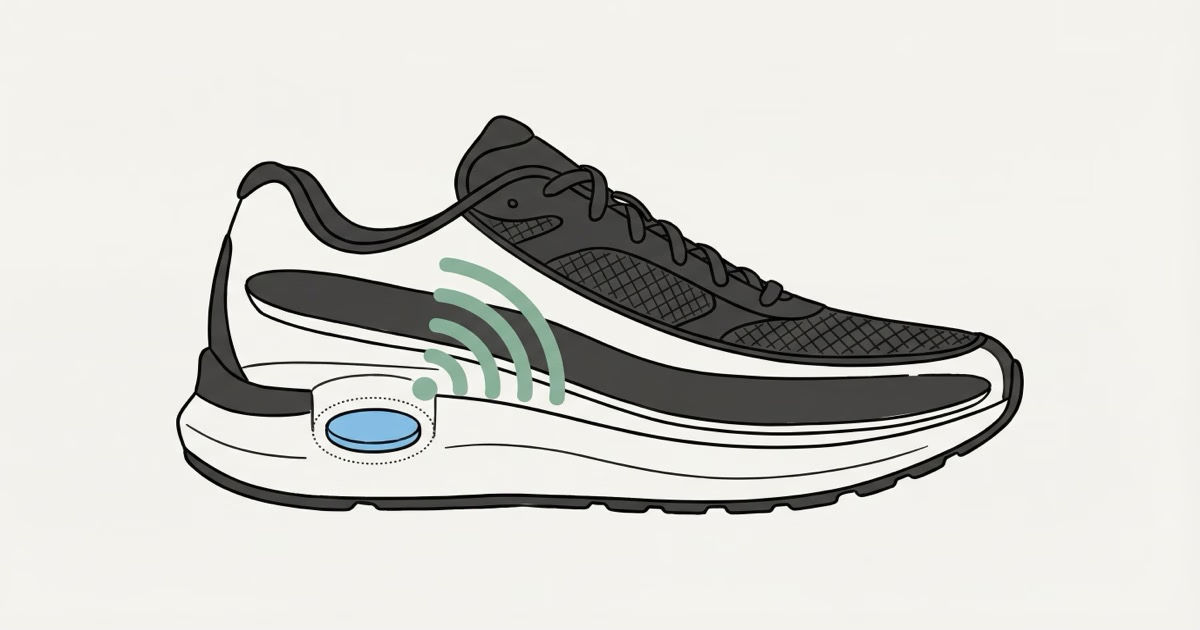
Three methods work: a dedicated AirTag insole (best for kids and elderly), a silicone shoelace clip (cheapest and easiest), or cutting a pocket into your existing insole (most discreet). For most people tracking sneakers or kids' shoes, a $10 insole insert like the TagSole+ is the simplest option. Drop the AirTag into the built-in pocket, slide the insole in, and you're done in 30 seconds.
AirTag wasn't designed to go inside a shoe. It's a 31.9mm disc meant for wallets and key rings. But shoes are the one item you always wear and almost never forget, which makes them the most reliable spot to track a child, protect expensive sneakers, or keep tabs on an elderly family member who wanders. The trick is picking the right holder method for the shoe type and the person wearing it.
Three Ways to Put an AirTag in a Shoe
An insole pocket, a shoelace clip, and a DIY cutout. Each trades off comfort, visibility, and swap speed differently.
| Method | Cost | Comfort | Visibility | Best For |
|---|---|---|---|---|
| AirTag insole insert | $8–15 | ✓ Good | ✓ Hidden | Kids, elderly, daily wear |
| Shoelace clip | $6–12 | ✓ No impact | ⚠ Visible | Quick swap, athletic shoes |
| DIY insole cutout | $0 | ⚠ Depends on insole | ✓ Hidden | Sneaker theft protection |
| Built-in shoe compartment | $52–58 (new shoes) | ✓ Excellent | ✓ Hidden | Kids (Skechers only) |
AirTag Shoe Insole Inserts: The Easiest Option
These are full or partial insoles with a built-in AirTag pocket, usually positioned under the arch or heel. You drop the AirTag in, close the flap, and place the insole inside any shoe. No cutting, no glue, no modifications to the shoe itself.
The TagSole+ is the one I'd recommend. It comes in sizes for kids (16–20cm) and adults, uses a snap-closure pocket at the arch, and sits at about 6mm thick, thin enough that most people don't notice it after the first day. The insole material is standard EVA foam, similar to what's already in your shoe.
Other brands like Sifemp and RFUNGUANGO sell similar products for $8–15 on Amazon. They all work on the same principle. The differences come down to sizing accuracy and foam quality. Cheap ones compress flat within a month, which lets the AirTag shift around inside the pocket.
One thing to watch: most AirTag insoles are sized for kids. Adult sizes above US Men's 10 are harder to find. If you wear larger shoes, the DIY cutout method or a shoelace clip is more practical.
Sizing for Kids' AirTag Insoles
Kids' insoles typically come in 3–4 size ranges: toddler (16–18cm), small child (18–21cm), big kid (21–24cm), and teen/small adult (24–27cm). You'll need to measure the inside length of the shoe, not the child's foot. Cut-to-fit insoles are more forgiving here. The AirTag pocket adds about 3mm of height at the arch, which most kids won't notice in sneakers but might feel in tight-fitting dress shoes.
One issue parents run into: kids' shoe sizes change every 4–6 months. If you buy a size-specific insole, it won't transfer to the next pair. Cut-to-fit insoles solve this since you can retrim them for the new shoe. The AirTag itself moves between insoles in seconds. Budget for replacing the insole insert, not the tracker. A $10 insole twice a year is still cheaper than any GPS subscription.
Why the AirTag Sits Under the Arch, Not the Heel
Heel placement sounds logical since there's more room. But you land on your heel with every step. An AirTag under the heel means 8mm of hard polycarbonate between your foot and the ground, and that pressure is noticeable within minutes. The arch bears less direct weight. That's why every commercial AirTag insole positions the pocket at the arch or midfoot.
DIY Method: Cutting an AirTag Pocket Into Your Insole
If you don't want to buy a separate insole, you can make one yourself. This is the best approach for sneaker theft protection because the AirTag is completely invisible, and a thief would need to pull out the insole to find it.
- Remove the shoe's insole. Most athletic shoes have pull-out insoles.
- Place the AirTag on the underside of the insole, at the arch area. Trace a circle about 33mm in diameter.
- Cut a recess using sharp scissors or a craft knife. For EVA foam insoles, scissors work fine. You want about 5 to 6mm depth, enough for the AirTag to sit below the insole surface without poking through.
- If your insole is thinner than 6mm, use sandpaper to remove 2–3mm of material from the shoe's midsole underneath the cutout.
- Drop the AirTag into the recess. It should sit flush or slightly below the surface.
- Replace the insole. The insole's weight and friction keep the AirTag in place.
Battery replacement means pulling out the insole once a year. Set a reminder. For more ways to use your AirTag, the full guide to AirTag uses covers 15 practical placements.
Shoelace Clips: Fastest to Install, Easiest to Spot
Silicone shoelace clips thread onto the shoe's laces or velcro strap and wrap around the AirTag. They're waterproof, cost $6–12 for a 2-pack, and take about 10 seconds to attach. Brands like XEEWEN and generic options on Amazon all work similarly.
The downside is obvious: anyone looking at the shoe can see it. For kids' shoes, that might not matter. For sneaker theft prevention, it defeats the purpose.
Shoelace clips work best when you need to move the AirTag between multiple pairs of shoes quickly. Swap the clip from school shoes to soccer cleats in seconds. You can find a full range of holder styles in the AirTag holders and accessories guide.
Skechers "Find My Skechers": Built-In AirTag Shoes
In July 2025, Skechers released kids' sneakers with a factory-built AirTag compartment hidden in the heel's midsole. You lift the insole and fabric liner, drop the AirTag into a plastic housing, and screw the lid shut. The compartment is molded into the sole, so there's zero effect on comfort and no signal interference.
They cost $52–$58, which is reasonable for kids' sneakers plus a built-in tracker solution. TechCrunch reported on the launch, and early reviews from parents have been positive.
The catch: it's Skechers only, kids' sizes only, and you still need to buy the AirTag separately. If your kid outgrows the shoes in six months (they will), you unscrew the AirTag and move it to the next pair. For families already in the Apple ecosystem, it's a clean solution. For everyone else, a $10 insole does the same job in any shoe.
AirTag Shoe Tracking for Kids
The primary reason parents put AirTags in kids' shoes: shoes are the one thing a child can't accidentally leave behind, hand off to a friend, or toss in a cubby. A tracker in a backpack only works if the kid carries the backpack. A tracker in a shoe goes where the kid goes.
Practical considerations for school-age children:
- iPhone density at schools is high. AirTag location updates depend on nearby iPhones in Apple's Find My network. In most schools, updates come every few minutes. The AirTag accuracy guide explains how update frequency varies by environment.
- Anti-stalking alerts will fire. Any iPhone-carrying teacher or parent near your child for extended periods may receive an "Unknown AirTag" alert. Tell the school about the tracker. Surprises create problems.
- AirTag 2 has the same dimensions as AirTag 1. Both are 31.9mm diameter, 8mm thick. Any insole or clip that fits one fits the other.
One more thing. If your child is old enough to carry an iPhone, Find My already tracks their location directly. The AirTag shoe insert is most useful for younger kids without phones, roughly ages 3 to 10.
AirTag Shoe Tracking for Elderly and Dementia Patients
Shoes are often the last thing a person with dementia removes before wandering. That makes shoe-based tracking a practical backup layer. Caregivers on the Alzheimer's Association community forums have reported using AirTag insoles as part of a broader safety plan.
But AirTag is not GPS. It doesn't track in real time. Location updates come only when another iPhone passes within Bluetooth range (about 30 feet). In a suburban neighborhood, that might mean updates every 10–30 minutes. In a rural area with few iPhones nearby, the AirTag could go hours without updating. The AirTag for elderly guide covers the full picture, including better alternatives for high-risk patients.
For mild cognitive impairment where occasional wandering is a concern, an AirTag insole adds a useful safety net. For moderate-to-severe dementia with frequent wandering episodes, a dedicated GPS tracker with real-time alerts is the right tool.
Does the Shoe Block AirTag's Bluetooth Signal?
No. Foam, rubber, leather, and synthetic shoe materials don't block Bluetooth. An AirTag buried under an insole broadcasts at the same effective range, roughly 30 feet (10 meters), as one sitting in the open. Apple's Find My privacy documentation confirms the network works through standard consumer materials without signal loss.
The only material that causes issues is metal. Some work boots have steel shanks for structural support, and placing an AirTag directly against metal can reduce signal range by 30–50%. For athletic shoes, casual shoes, and kids' sneakers, signal is not a concern.
Sneaker Theft: Does an AirTag Actually Help Recover Stolen Shoes?
Limited-edition sneakers worth $200–$500+ are a real theft target. An AirTag hidden under the insole gives you the best chance of tracking where those shoes end up. If someone steals your Jordans from a gym locker, the AirTag broadcasts its location to every iPhone it passes. You'll see the location update in Find My, and you can share that information with police.
It won't stop the theft. It won't alert you in real time. You'll notice the shoes are gone, check Find My, and see a last-known location. For more on what happens after theft, see the AirTag theft recovery guide.
There's also a built-in timer working against you. The thief's iPhone will eventually alert them that an unknown AirTag is traveling with them. Apple's anti-stalking system triggers after roughly 8 to 24 hours, at which point they'll find the AirTag and toss it. That gives you a window to identify a general location and share coordinates with police, but not enough time for a drawn-out investigation. How quickly you act after discovering the theft matters more than anything. For details on how the alert system works, see the "AirTag found moving with you" guide.
AirTag 2 vs AirTag 1 for Shoe Use
Identical fit. Both are 31.9mm diameter and 8mm thick. Every insole, clip, and DIY cutout that works for AirTag 1 works for AirTag 2 with no modifications.
The AirTag 2 adds a built-in speaker that's louder, improved UWB Precision Finding range (up to 60 meters vs 15 meters on the original), and a new Notify When Left Behind feature that alerts you if you walk away from your shoes. That last feature is actually useful for shoe tracking. If you leave a gym and forget your AirTag-equipped shoes in the locker, your iPhone pings you.
What About Smaller Trackers?
If the AirTag's 31.9mm disc feels too bulky for a specific shoe, smaller options exist. The Tile Sticker is 27mm diameter and 7.4mm thick, slightly smaller, but it uses Tile's network (far fewer devices than Apple's Find My). The Chipolo ONE Point is similar in size to AirTag but works on Apple's Find My network. Neither is dramatically smaller. The AirTag alternatives guide covers all current options with size comparisons.
For shoes specifically, the AirTag's size isn't the real problem. The 8mm thickness is. And no competing Bluetooth tracker has solved that. They're all in the 6 to 8mm range.
Bottom Line
A TagSole+ insole and an AirTag 2 gets you a working shoe tracker for under $40 with no monthly fees. Kids, elderly family members, sneaker collectors. The setup takes 30 seconds and the battery lasts a year. It's not GPS, it won't track in real time, and a determined thief can find and remove it. But for the price of a cheap lunch, you get a location signal that's better than nothing and often good enough to recover what matters.
Frequently Asked Questions
Will I feel the AirTag under my foot when walking?
With a proper insole that positions the AirTag at the arch, no. The arch bears less direct pressure than the heel or ball of the foot. Commercial AirTag insoles like the TagSole+ add about 3mm of height at the pocket area, which most people stop noticing after a day. If you place the AirTag under the heel with no cutout, you'll feel every step. That 8mm disc is impossible to ignore under direct body weight.
Can the AirTag break from the pressure of walking on it?
AirTag's polycarbonate and stainless steel construction handles normal walking and running pressure without damage. Your body weight is distributed across the foot, not concentrated on the 31.9mm disc. Running, jumping, and sports are all fine. The battery door seal is the component most likely to degrade under repeated compression, but a proper arch-positioned insole prevents direct pressure on the door.
How often do I need to replace the AirTag battery in a shoe?
About once a year. AirTag uses a standard CR2032 battery that Apple rates for approximately 12 months of normal use. You'll get a low-battery notification in Find My several weeks before it dies. Apple's battery replacement guide shows the twist-off process: pull the insole, swap the battery, put it back. Two minutes.
Does Skechers make AirTag shoes for adults?
Not yet. The "Find My Skechers" line launched in July 2025 covers kids' sizes only, priced at $52–$58. Skechers hasn't announced adult versions. For adult shoes, an aftermarket insole insert or DIY cutout is your option.
Is it legal to put an AirTag in someone else's shoe?
Tracking another person without their knowledge or consent is illegal in most jurisdictions, regardless of your relationship. This applies to spouses, partners, and adult family members. For minor children, parents generally have legal authority to track their kids. For elderly family members with dementia, consult local laws. Some states have specific provisions for caregiver tracking with medical authorization. Apple's anti-stalking system will alert any iPhone user that an unknown AirTag is traveling with them within 8–24 hours.
Can airport security detect an AirTag in my shoe?
Yes. AirTag contains electronic components and a lithium battery that show up on X-ray. When shoes go through the scanner, security staff may flag the small disc-shaped object and ask you to explain it. AirTag isn't prohibited on flights, but it's unfamiliar to some screeners. Be ready to take 30 seconds to explain what it is. Not a big deal, but don't be surprised when they ask.
What's the best shoe type for hiding an AirTag?
Athletic shoes with thick removable insoles — trail runners, cross-trainers, and hiking boots from brands like Brooks, HOKA, and Salomon. These have 8–12mm EVA insoles with enough depth to accommodate the AirTag at the arch without any noticeable bulge. Avoid flat-soled shoes (canvas sneakers, dress shoes, minimalist runners) where even 3mm of added height is immediately felt.