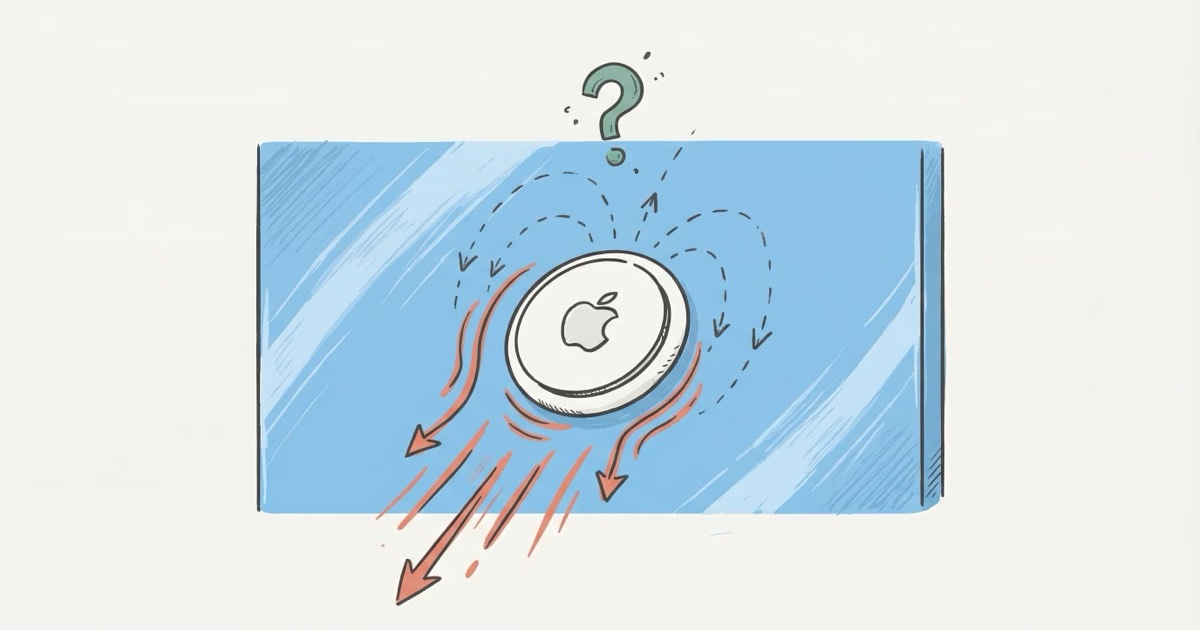
No, AirTags won't stick to metal on their own. There's a small magnet inside the speaker assembly, but it produces barely enough force to hold a paperclip. For magnetic mounting, you need a third-party case with embedded neodymium magnets. The Elevation Lab TagVault Magnetic is the strongest option, with an oversized N52 magnet and IP68 waterproofing.
Pick up an AirTag and press it against your fridge. It slides right off. Try a filing cabinet, a car door, a steel toolbox. Same result every time. The disc just won't hold.
This surprises people because the stainless steel back looks like it should be magnetic. It isn't. And the tiny magnet buried inside the speaker? It's there to make sound, not to mount anything.
So if you want to slap an AirTag onto your car frame, bike, or gun safe, you'll need a magnetic case to do the heavy lifting. This guide covers what's actually inside an AirTag, which magnetic holders work best, and where people are mounting them.
Is There a Magnet Inside an AirTag?
Technically, yes. But it's not what you think.
The iFixit teardown of the original AirTag showed that the speaker is built into the body of the device itself. A small magnet sits inside a copper voice coil on the logic board. When the AirTag plays a sound, electrical current runs through the coil, vibrating the magnet against the plastic battery cover to produce noise. The entire back panel acts as a speaker diaphragm.
That magnet generates maybe 0.5 to 1 pound of pull force at best. Enough to make the AirTag chirp when you ping it from Find My. Nowhere near enough to hold 1.07 ounces of tracker against a vertical metal surface, let alone survive vibration from a moving car.
What Changed in AirTag 2's Speaker Design
Apple redesigned the internals for the second-generation AirTag 2, but the magnetic story stayed the same.
According to 9to5Mac's teardown coverage, the AirTag 2 has a slightly larger speaker coil (which explains the louder sound Apple advertises) and significantly more adhesive securing the magnet to the board. Apple added that glue as an anti-tampering measure. Stalkers were removing the speaker magnet from first-gen AirTags to silence the anti-stalking alert sound. The extra adhesive makes that harder, though not impossible. If you've ever wondered why your AirTag beeps, that speaker magnet vibrating against the case is what produces the sound.
The magnet itself? Still tiny. Still weak. Still not designed for mounting.
Why the Stainless Steel Back Isn't Magnetic
AirTag's polished back cover is made of 316L stainless steel, the same alloy Apple uses in the Apple Watch Ultra. This particular grade is austenitic, which means it's essentially non-magnetic. You can hold a strong refrigerator magnet against it and feel almost nothing.
Some cheaper stainless steel alloys (like 430 series) are ferromagnetic and would attract magnets. Apple didn't use those. The 316L choice prioritizes corrosion resistance and skin-friendliness over magnetic properties.
Bottom line: neither the internal magnet nor the external shell will let an AirTag stick to anything on its own.
How Magnetic AirTag Cases Work
Magnetic AirTag holders solve the problem by embedding one or more neodymium magnets (usually N52 grade, the strongest commercially available) into a protective shell. You place the AirTag inside, screw or snap the case shut, and press it against any ferromagnetic surface. The case does the gripping. The AirTag just rides along.
Most holders use a single large disc magnet on the flat side. Better ones use an oversized magnet that extends beyond the AirTag's diameter for a wider contact area and stronger hold. The housing is typically silicone, ABS plastic, or a PC composite, all of which let Bluetooth and UWB signals pass through without interference.
One thing to watch: fully metal-enclosed cases can degrade Bluetooth range by 30-50%. Keep the white side (the AirTag's antenna face) exposed or behind plastic, not behind a metal plate.
Best Magnetic AirTag Holders Compared
| Holder | Magnet Grade | Pull Force | Waterproof | Best For |
|---|---|---|---|---|
| Elevation Lab TagVault Magnetic | N52 (oversized) | ~15 lb | IP68 | Under-car, trailer, equipment |
| Mars Outpost Neodymium Case | N52 | ~12 lb | IP67 | Vehicle underbody, wheel well |
| Budget silicone magnetic cases | N45–N52 | ~5 lb | IP67 | Bike frame, toolbox, cabinet |
| Generic silicone + magnet cases | N45–N50 | ~3–5 lb | Varies | Light-duty indoor use |
The Elevation Lab TagVault Magnetic is the one I'd pick for anything automotive. The oversized neodymium magnet grips steel surfaces hard enough that you have to pry it off with your fingernails. The screw-on lid keeps water and road grime out, and it works with both AirTag 1 and AirTag 2.
For lighter jobs like sticking an AirTag to a metal filing cabinet or the inside of a locker, a $6-8 silicone case from Amazon does fine. Just don't trust it under a car at 70 mph.
One detail people miss: magnet strength depends on surface thickness too. A thin sheet-metal locker door gives less grip than a thick steel I-beam. If your mounting surface is thin gauge metal (like a car's inner fender), test the hold by pressing the case on and giving it a firm tug before you rely on it.
Where to Mount a Magnetic AirTag
Magnetic cases open up a lot of mounting options that adhesive and keyring holders can't match. Here are the most popular spots:
Cars and Trucks
The most common use case by far. People attach magnetic AirTag cases to the underside of a bumper, inside a wheel well, behind a license plate bracket, or on the steel frame under the dash. For car tracking with AirTags, a magnetic mount rated for 10+ pounds of pull force is the minimum. Anything less risks the case shaking loose on rough roads or at highway speeds.
The best mounting surfaces on most cars are the steel frame rails running under the body and the inside of the rear bumper. Both are thick enough to give a strong magnetic grip and protected from direct road spray. Avoid mounting on thin sheet-metal panels like fender liners, where the metal is too thin for reliable hold. Always test by pressing the case on and giving it a firm downward tug before you drive.
Pair the case with IP67 or IP68 waterproofing if mounting anywhere exposed to rain, mud, or road spray. The Elevation Lab TagVault and Mars Outpost cases both seal tight enough to survive months under a vehicle without moisture getting in. For covert placement ideas, the AirTag hiding spots guide covers 7 tested locations inside and under a vehicle.
Bikes
Steel-frame bikes give you a flat surface on the down tube or seat tube where a magnetic case sticks directly. Carbon and aluminum frames won't work with magnets. For those, you'll need a dedicated bike mount that bolts on or fits inside the steerer tube. Magnetic mounting is quick but less secure for theft prevention. If that's the main goal, hide the AirTag inside the steerer tube instead.
Metal Equipment and Storage
Toolboxes, generators, trailers, gun safes, metal lockers, server racks, construction equipment. Any ferromagnetic steel surface works. A 5 lb pull-force silicone case is plenty for stationary objects. Just stick the case to the inside wall, check it's secure, and forget about it until you need to track the item.
Gun safe owners in particular like this approach. Stick a magnetic AirTag case to the inside of the safe door. If someone steals the entire safe (it happens more often than you'd think), Find My will show you where it went. The thick steel walls of most safes reduce Bluetooth range, but the AirTag only needs to ping a passing iPhone within about 10-15 feet once to update its location.
Will Magnets Damage an AirTag?
No. External magnets don't harm AirTag's electronics, Bluetooth radio, or UWB chip. The CR2032 battery is unaffected by magnetic fields. And Bluetooth operates at 2.4 GHz, which magnets can't interfere with.
The only scenario that causes problems is placing an AirTag inside a fully enclosed metal case (like a steel box with no plastic window). That blocks or weakens the Bluetooth signal, reducing the range from the normal 30-50 feet down to 10 feet or less. Signal blockage is a shielding issue, not a magnetic one.
Do Magnetic Cases Affect Credit Cards or Phones?
Modern credit cards store data on EMV chips, which magnets can't erase. The dark magnetic stripe on the back is technically vulnerable to strong magnets held in direct contact for extended periods, but an AirTag magnetic case sitting in the same bag or pocket isn't going to do anything to it.
iPhones are designed to work around magnets (MagSafe uses them intentionally). An AirTag in a magnetic case won't affect your phone's compass, screen, or storage. Apple's own guidelines on magnets and devices confirm that modern Apple products are built to tolerate magnetic accessories.
Pacemakers are a different story. Apple recommends keeping magnetic accessories at least 6 inches away from implanted medical devices. Worth noting if you carry a magnetic AirTag case in a chest pocket.
Can AirTag Work with MagSafe?
Not natively. AirTag doesn't have a MagSafe magnet ring, so it won't snap onto an iPhone case or MagSafe wallet mount. A few third-party adapters add a MagSafe-compatible ring around the AirTag, but these are niche products that add unnecessary bulk.
The better question is whether you even need MagSafe compatibility. MagSafe's magnet array is designed for alignment and attachment to flat iPhone backs. AirTags go on keys, in bags, under car bumpers. The use cases don't overlap much. A standard keyring loop or adhesive mount covers 95% of what people actually need.
Magnetic vs. Adhesive vs. Screw-On Mounts
Magnetic isn't always the right call. Here's when each mounting method makes sense:
Magnetic cases are best when you need to attach and detach quickly, or when you're mounting to a steel surface you can't drill into. Great for car frames, metal cabinets, gym lockers. Downside: only works on ferromagnetic metals, and a determined thief can pull it off.
Adhesive mounts (3M VHB tape) stick to any clean, smooth surface including plastic, glass, and aluminum. Harder to remove than magnetic, but also harder to reposition. The Elevation Lab TagVault Surface uses industrial adhesive rated for outdoor temperatures.
Screw-on and bolt-on mounts are the most secure. The AirTag holders and accessories guide covers options like cage mounts for bikes and Torx-screw cases for vehicles. These resist theft and vibration better than magnets, but installation takes tools and time.
The Bottom Line
AirTags aren't magnetic enough to mount anywhere on their own. You need a third-party case with neodymium magnets to stick one to a car frame, toolbox, or metal cabinet. The Elevation Lab TagVault Magnetic is the strongest option for vehicles and outdoor use. For lighter indoor jobs, any $6-8 silicone magnetic case from Amazon works fine. The magnets won't damage your AirTag, your phone, or your credit cards.
Frequently Asked Questions
Are AirTags magnetic?
Barely. The speaker assembly contains a small magnet for producing sound, but its pull force is under 1 pound. An AirTag placed on a metal surface will slide off immediately. For magnetic mounting, you need a third-party case with a neodymium magnet built in.
Can I stick an AirTag directly to my car?
Not without a case. The AirTag's internal magnet is far too weak. Get a magnetic holder rated for at least 10 lbs of pull force and IP67 or IP68 waterproofing. Elevation Lab's TagVault Magnetic and Mars Outpost's neodymium case are the two most popular options for vehicle use.
Will a magnet damage my AirTag?
No. Bluetooth signals, the U1/U2 UWB chip, NFC, and the CR2032 battery are all unaffected by external magnetic fields. You can safely use any strength of neodymium magnet around an AirTag without worrying about data loss or component damage.
Do magnetic AirTag cases block the Bluetooth signal?
Silicone and plastic cases with embedded magnets don't block Bluetooth at all. The signal passes through just fine. The only risk is a fully enclosed metal case that wraps the AirTag on all sides, which can cut Bluetooth range significantly. Stick with cases that leave the white plastic top exposed.
What's the strongest magnetic AirTag mount?
The Elevation Lab TagVault Magnetic uses an oversized N52 neodymium magnet rated around 15 lbs of pull force. That's strong enough for highway-speed vehicle tracking. Mars Outpost's offering is close at roughly 12 lbs. Both are IP67+ waterproof and compatible with AirTag 1 and 2.
Why does my AirTag slightly stick to metal sometimes?
That faint tug you feel is the speaker magnet. It's strong enough to create a slight attraction to ferromagnetic surfaces, but nowhere near strong enough to hold the AirTag in place. Think of it like a refrigerator magnet that's been worn down to 10% strength. You can feel it, but it can't hold anything up.
Can I use a magnetic AirTag case on an aluminum surface?
No. Aluminum is non-ferromagnetic, so magnets won't stick to it. Same goes for brass, copper, and most stainless steel alloys. Magnetic cases only grip ferromagnetic metals like mild steel, cast iron, and some nickel alloys. For aluminum surfaces, use an adhesive mount or a bolt-on case instead.