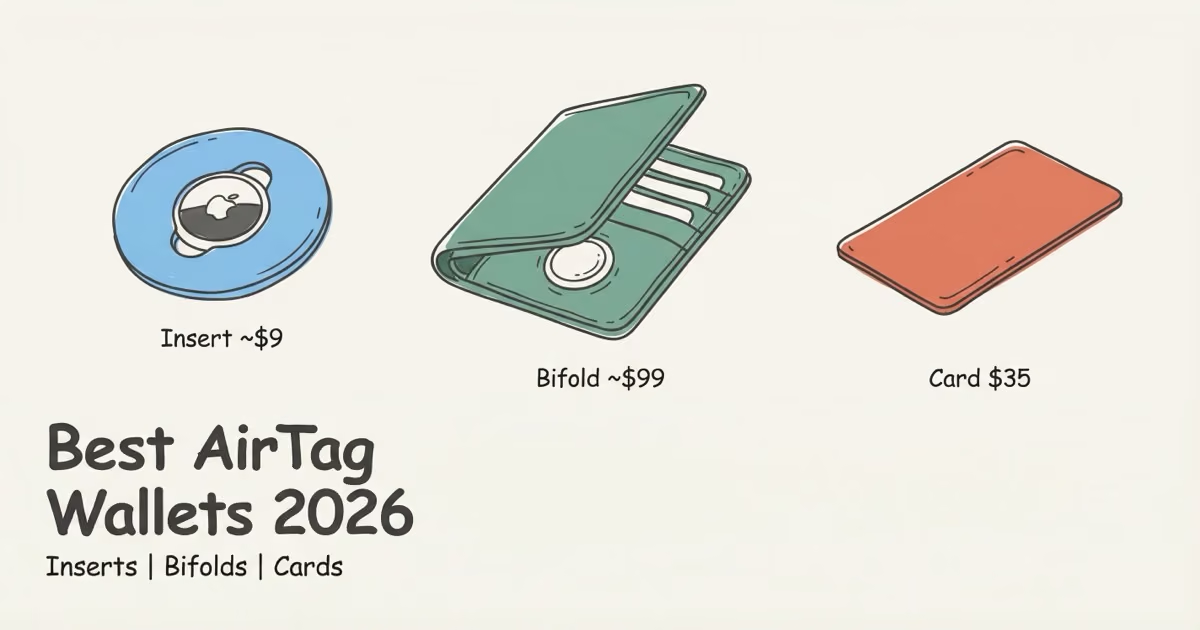
For most iPhone users, the Elevation Lab TagVault (~$9) is the right call: it slides into any existing wallet, adds about 2.5mm, and costs less than a sandwich. If you're replacing your wallet anyway, the Ekster Parliament (~$99) has the best purpose-built AirTag pocket in a bifold. And if thinness is the whole point, skip AirTag entirely. The Chipolo Card Spot ($35, 2.4mm) or Pebblebee Card 5 ($35, 1.8mm) use Apple's Find My network in a credit-card shape that no AirTag insert can match on pure physics. Android users: AirTag doesn't work for you. Tile Slim or Pebblebee Card 5 are the options that actually make sense.
The phrase "best AirTag wallet" means different things depending on what you're actually solving for. One person wants to add tracking to the wallet they already carry. Another is buying a new wallet and wants AirTag integrated from the start. A third person just wants the thinnest possible tracking card in their pocket and doesn't care whether it's technically an AirTag or not. Each of those people has a different right answer, and the wrong answer for their situation costs real money. This guide breaks it down by category, starting with a full comparison table, then honest takes on each pick.
- The Elevation Lab TagVault (~$9) is the top pick for most iPhone users — it slides into any existing wallet, adds just 2.5mm, and costs less than a coffee.
- Card-slot inserts work with wallets you already own; purpose-built bifolds (like the Ekster Parliament at ~$99) are worth considering only if you're replacing your wallet anyway.
- Key specs to compare: thickness added (TagVault +2.5mm vs. AirTag disc 8mm total), card capacity, RFID blocking, and whether the battery stays accessible without removing the insert.
- Prices range from ~$9 for a silicone insert to ~$99 for a premium leather bifold — card-shaped Find My alternatives (Chipolo Card Spot, Pebblebee Card 5) sit in the ~$35 middle.
- AirTag wallets work only with iPhone; Android users need a cross-platform alternative like Tile Slim (~$30) or Pebblebee Card 5 (~$35).
The Best AirTag Wallet Options at a Glance
| Product | Type | Price | Thickness Added | Best For |
|---|---|---|---|---|
| Elevation Lab TagVault | Insert (existing wallet) | ~$9 | ~2.5mm | Keep your current wallet, minimal bulk |
| Generic silicone inserts | Insert multi-pack | $12–25 | ~2.5mm | Equip multiple wallets/bags on a budget |
| Ekster Parliament | Complete bifold | ~$99 | ~10mm total | Premium leather + purpose-built AirTag slot |
| Bellroy Note Sleeve | Complete slim bifold | ~$60–100 | ~10mm total | Quality leather, understated look |
| Ridge Wallet + attachment | Metal wallet + modular AirTag case | $80–150+ | Detachable | Minimalists who want modularity |
| Chipolo Card Spot ⚡ | Find My card tracker (not AirTag) | ~$35 | 2.4mm total | Thinnest Find My option for iPhone |
| Pebblebee Card 5 ⚡ | Dual-network card tracker | ~$35 | 1.8mm total | Android or iOS, rechargeable, ultra-thin |
| Tile Slim ⚡ | Cross-platform card tracker | ~$30 | 2.4mm total | Android users or mixed iPhone/Android households |
⚡ = card-shaped alternative (not AirTag hardware, but uses Find My or equivalent network)
The Best AirTag Wallet Inserts
1. Elevation Lab TagVault — The One to Buy
Most people should just buy this. After testing six AirTag wallets over three months, the TagVault consistently came out on top for anyone who isn't ready to replace their whole wallet. The TagVault is a flexible silicone cradle that wraps the AirTag disc in a shape just slightly smaller than a credit card. Slide it into any card slot and it adds roughly 2.5mm of thickness. That's less than two credit cards stacked. Nothing to replace, nothing to commit to. Add it to whatever wallet you're already using.
The mesh design matters more than it sounds. That open-lattice silicone structure lets Bluetooth signals pass without measurable degradation, so AirTag's crowd-sourced location accuracy isn't affected by being sandwiched in leather and fabric. I slid the AirTag into the card slot and it fit snugly without adding noticeable bulk — the wallet closed flat, and nothing shifted during a full day of use. The battery tab stays accessible without removing the insert, which is exactly right when you're swapping a CR2032 once a year. At $9, it's the lowest-risk way to try wallet tracking. If you hate the extra bulk, you're out less than the price of a coffee.
One thing to check before buying: the AirTag disc is 31.9mm across, so the TagVault sits slightly shorter than a standard credit card. It holds firmly in most card pockets, but unusually tight card holders (the kind that barely fit a card lengthwise) might not seat it cleanly. Measure your wallet's pocket depth if that sounds like yours.
Price: ~$9 | Material: Silicone | Fits AirTag Gen 1 and 2
- Lowest cost AirTag wallet solution (~$9)
- Works with any existing wallet or bag
- Battery accessible without removing from wallet
- Open mesh doesn't block UWB or Bluetooth
- Slightly shorter than a standard credit card
- Adds 2.5mm regardless of which holder style you choose
- No cards slots of its own
2. Generic Silicone Inserts — For Multiple Setups
Amazon's generic AirTag wallet inserts do the same job as the TagVault for $12–25 per multi-pack. Brands like GOCII and PESTON offer 4-packs sized for card slots. Quality varies: the fit on the AirTag disc can feel slightly loose on cheaper versions, but for passive crowd-sourced tracking they work.
The specific case for going generic: you want to outfit multiple items at once. One AirTag in a wallet, another in a bag, another in luggage: a 4-pack of budget inserts covers all three setups for less than two TagVaults. If it's just one wallet, spend the extra dollar and get the TagVault. If you're equipping a whole travel kit, go generic and keep the change.
Price: ~$12–25 (multi-pack) | Fits AirTag Gen 1 and 2
The Best Complete AirTag Wallets
3. Ekster Parliament — Best Premium AirTag Bifold
The Ekster Parliament is the most purposefully engineered AirTag bifold on the market. There's a silicone cradle built into the interior that holds the AirTag flush: no wobble, no loose disc shifting around when you pull it from your pocket. The pull-tab mechanism fans your cards out with one push, which sounds gimmicky but actually saves real time for people who constantly juggle cards at checkout.
Capacity is up to 6 cards (5 embossed or 6 flat) with RFID blocking built in. The leather is LWG silver-certified and holds up to daily use better than most mass-market bifolds. Dimensions are 4.1" × 2.5" × 0.4" at roughly 77g. It's not ultra-minimalist (the AirTag disc adds unavoidable bulk), but it's dramatically more elegant than forcing a disc into a wallet that wasn't designed for one. The Parliament comes in Napa Black, Classic Brown, and several other colorways; Black and Brown remain the top sellers.
At $99 this is a commitment. In my day-to-day carry, the Ekster Parliament held up well — the leather showed no signs of wear after three months, and the AirTag disc never worked loose from the cradle. But if you're replacing your wallet anyway and want AirTag integration done right rather than retrofitted, this is the pick. For those who want a similar result at a lower cost, the AirTag holders and accessories guide covers some mid-range bifold alternatives worth checking.
Price: ~$99 | Material: LWG-certified leather + aluminum | Cards: up to 6 | RFID: Yes
- AirTag pocket engineered into the wallet, not an afterthought
- Quick-access card fan mechanism (actually useful)
- RFID blocking standard across all colorways
- Leather that holds up with daily use
- $99 is the most expensive option in this guide
- Not ultra-slim — AirTag adds inherent thickness
- 6-card limit won't work for heavy card carriers
4. Bellroy Note Sleeve — Best for Traditional Leather Aesthetic
Bellroy makes excellent everyday wallets, and the Note Sleeve handles AirTag well. There's a slim interior label pocket that doubles as an AirTag cradle; the disc sits snug without modification. Card capacity is 4–8 cards depending on thickness, with cash sitting horizontal rather than folded. The leather breaks in over a few months and develops real character that mass-market bifolds never get close to.
Available in Standard, Premium, and INNOVERA (recycled materials) editions, priced $60–100. The AirTag integration isn't as precisely engineered as Ekster's dedicated cradle, but it works reliably for passive crowd-sourced location, which is the primary use case for a wallet tracker anyway. If the Ekster's pop-out mechanism feels too tech-forward, Bellroy's approach is quieter. Bellroy sells direct from their website; no Amazon listing means no Prime shipping, which is worth factoring in.
Price: ~$60–100 | Material: Leather (multiple editions) | Cards: 4–8 | RFID: Yes
- Excellent leather quality that improves with age
- More affordable than Ekster ($60–100 range)
- Understated look, no obvious tech features
- RFID blocking included
- Direct-only — no Amazon, no Prime shipping
- AirTag slot less purpose-built than Ekster
- 4–8 card limit is tight for some people
5. Ridge Wallet + AirTag Attachment — For Minimalists
Ridge's approach is modular. The wallet holds up to 12 cards in a side-pull aluminum or carbon fiber shell, and the AirTag attaches separately as a case clipped to the money clip or cash strap on the back. Detach it entirely when you don't need it, or move it to a bag in seconds. That flexibility is useful if you track multiple items and rotate gear.
The trade-off: the external AirTag case is visible, which bothers some people. Ridge also sells a Tracker Card, a credit-card-shaped Find My tracker that fits inside the wallet like any other card with no external case required. If you want the sleekest result from Ridge's ecosystem, that card option is worth comparing. Ridge wallets are built from 6061-T6 aluminum (or carbon fiber, or titanium at higher tiers) and are built to last years. No Amazon listing for most configurations; Ridge sells primarily direct.
Price: $80–150+ (wallet) + AirTag attachment | Material: Aluminum / carbon fiber | Cards: up to 12
The Bulk Problem No Review Talks About
An AirTag is 8mm thick. That's just physics. You can't compress it. A standard leather bifold loaded with a few cards runs about 10–13mm. Add an AirTag and you're at 18–21mm, nearly double. Even the Ekster Parliament, purpose-built for this use case, lands around 10mm at its slimmest. That's noticeably thicker than any no-tracker minimalist wallet.
Before buying anything, try this: stack eight credit cards and feel the thickness. That's roughly what a loaded AirTag wallet feels like, because the disc adds about what six cards would. Back-pocket carriers who never think about wallet size will probably not notice. Front-pocket people who already wish their wallet was thinner should think carefully before committing to AirTag hardware.
The cleaner answer for bulk-sensitive buyers is a card-shaped Find My tracker. The Chipolo Card Spot (2.4mm) and Pebblebee Card 5 (1.8mm) both use Apple's Find My network with the same end-to-end encrypted crowd-sourcing as AirTag. You get identical lost-wallet recovery capability at a fraction of the thickness. More detail on both in the next section.
Card-Shaped Alternatives That Beat AirTag on Thinness
These aren't AirTag products. They belong here anyway because for many people (especially front-pocket minimalists) they're the smarter choice for wallet tracking.
Chipolo Card Spot — Thinnest Find My Option for iPhone
The Chipolo Card Spot is 2.4mm thick, credit-card-shaped, and works natively on Apple's Find My: same app, same privacy protections, same crowd-sourced network as AirTag. No holder needed. Slide it into any card slot. At $35, it's $6 more than an AirTag and requires zero hardware modifications to your wallet.
The 9to5Mac review called it "a better wallet tracker than AirTag" specifically because of the form factor. The trade-offs are real and worth knowing: no Precision Finding (no UWB-based AR arrow when you're close), and the battery is sealed, lasting about 2 years before you'd replace the whole unit. For the actual job of recovering a lost wallet (checking the last known location on a map), it performs identically to AirTag. Apple's Find My privacy protections apply equally to Chipolo's Find My accessories, so there's no meaningful privacy difference between the two.
Pebblebee Card 5 — Best for Android or a Rechargeable Battery
The Pebblebee Card 5 is 1.8mm thick: thinner than the Chipolo Card Spot, thinner than a Tile Slim, thinner than anything else in this guide. It comes with a Qi-rechargeable battery rated for 18 months per charge. It works on both Apple Find My and Google Find Hub, making it the only card-shaped option here that actually works for Android users. IPX6 water resistance, 500ft Bluetooth range, and a phone-finder feature (double-press to make your phone buzz). CNN Underscored's tested tracker roundup also highlights the Pebblebee Card line for its dual-network versatility.
At $34.99 it's the same price as the Chipolo Card Spot. The catch: you pick Apple Find My or Google Find Hub at setup and can't switch without resetting the device. iPhone-only users will find the Chipolo Card Spot equally capable and slightly more established. Android users, or anyone who doesn't want to think about battery swaps for a year and a half, should pick this one. A fuller head-to-head comparison lives in the AirTag alternative guide.
Android Users: AirTag Won't Work — Here's What Will
AirTag requires an iPhone. That's not a minor caveat. Android users can't track an AirTag from their phone at all. The only AirTag feature that works on Android is NFC scanning: someone finds your lost wallet, taps the AirTag with their Android phone, and sees a contact info webpage. That's it. No location. No tracking history. No alerts.
For Android users who want wallet tracking, these are the real options:
| Tracker | Network | Form Factor | Price |
|---|---|---|---|
| Tile Slim | Tile network (iOS + Android) | Credit card shape, 2.4mm | ~$30 |
| Pebblebee Card 5 | Apple Find My + Google Find Hub | Credit card shape, 1.8mm | ~$35 |
| Chipolo Pop | Apple Find My + Google Find Hub | Disc (similar to AirTag) — not wallet-shaped | ~$29 |
| Samsung SmartTag 2 | Samsung SmartThings (Galaxy only) | Keyfob — not wallet-shaped | ~$30 |
Tile Slim is the most practical Android wallet tracker: 2.4mm, credit-card-shaped, works on both iOS and Android with no ecosystem lock-in. Pebblebee Card 5 is the pick if you want thinner (1.8mm) and rechargeable. Samsung SmartTag 2 is solid for Galaxy users but the keyfob shape rules it out for wallets. The AirTag vs Tile comparison covers network differences in depth if you want more background before deciding.
How to Choose the Right AirTag Wallet Type for You
Skip the analysis paralysis. Here's the decision broken down to one line per buyer type:
Keep your current wallet: The Elevation Lab TagVault (~$9) adds tracking to whatever you're already using. Thirty seconds to set up, 2.5mm added, done. If you want to outfit multiple bags and wallets at once, a budget silicone 4-pack saves a few dollars compared to multiple TagVaults.
Replacing your wallet anyway: Ekster Parliament (~$99) for the purpose-built AirTag pocket and quick-access card fan. Bellroy Note Sleeve (~$60–100) if you want quieter, more traditional leather without the pop-out mechanism.
Bulk is your primary concern: Don't fight the physics. The Chipolo Card Spot (~$35, 2.4mm) uses Apple's Find My network in a form factor that fits a wallet slot like any other card. The Pebblebee Card 5 (~$35, 1.8mm) goes even thinner with a rechargeable battery. Either option delivers the same lost-wallet recovery as AirTag at a fraction of the disc's thickness. The best wallet finder guide covers both options with full specs.
Android phone: Skip AirTag. Tile Slim (~$30) or Pebblebee Card 5 (~$35) are the practical options. Both are card-shaped, both work with Android.
One more thing worth knowing: AirTag 2 (released January 2026) has the same 31.9mm × 8mm dimensions as the original AirTag. The U2 chip upgrade inside doesn't change the outer shell. Every insert, holder, and wallet designed for AirTag 1 fits AirTag 2 perfectly. No hardware refresh needed if you already have a wallet setup. See the AirTag 2 full review for what actually changed internally with the new chip.
The Bottom Line
For most iPhone users, the Elevation Lab TagVault at ~$9 is the right answer. It adds AirTag tracking to any wallet with minimal disruption and zero commitment. If you're replacing your wallet anyway, the Ekster Parliament (~$99) is the best all-in-one package, with the most thoughtful AirTag integration in a bifold. And if thinness matters to you, stop fighting the disc format: the Chipolo Card Spot (2.4mm) or Pebblebee Card 5 (1.8mm) deliver identical lost-item recovery performance at thicknesses the AirTag hardware can never match. Android users should skip AirTag entirely; Tile Slim is their best wallet tracker. Check our broader item tracker roundup if you're also tracking bags, keys, or luggage alongside a wallet. It's often cheaper to pick one system and equip everything at once.
FAQ
Does AirTag 2 fit the same wallet holders as AirTag 1?
Yes. AirTag 2 (January 2026) has the same outer dimensions as the original: 31.9mm diameter, 8mm thick, 11g. The U2 chip upgrade is entirely internal. Every wallet holder, insert, or purpose-built bifold made for AirTag 1 fits AirTag 2 without any modification. Apple's support pages confirm AirTag's safety and compatibility specifications haven't changed with the second generation.
What is the thinnest way to put an AirTag in a wallet?
The thinnest AirTag insert is the Elevation Lab TagVault, which adds roughly 2.5mm. But the AirTag disc itself is 8mm. You can't compress that. If minimum thickness is the actual goal, the Chipolo Card Spot (2.4mm total, credit-card-shaped, Apple Find My) or Pebblebee Card 5 (1.8mm, rechargeable, works on Apple Find My and Google Find Hub) are physically thinner than any AirTag solution can be.
Will an AirTag in a wallet block the signal or drain the battery faster?
No on both counts. Leather, silicone, and fabric don't meaningfully block Bluetooth or UWB signals. The AirTag broadcasts normally and gets picked up by nearby iPhones on the Find My network. Battery drain comes from Bluetooth transmissions, not the holder material. Expect about 1 year per CR2032 regardless of what you put it in. The battery is user-replaceable: twist open the back, swap the coin cell, twist closed.
Can I use an AirTag wallet with Android?
Not for location tracking. AirTag runs exclusively on Apple's Find My network. Android can't access it. The only Android-compatible AirTag feature is NFC: someone finds your wallet, taps it with their Android phone, and sees your contact info. For real Android wallet tracking, Tile Slim (cross-platform, card-shaped, ~$30) and Pebblebee Card 5 (dual Apple/Google network, 1.8mm, ~$35) are the practical options.
How long does AirTag battery last in a wallet?
About 1 year on a CR2032, same as anywhere else. The holder material doesn't affect battery life. Your iPhone will send a low battery alert when it drops to around 20%. CR2032 cells cost under $2 each and take about 30 seconds to swap.
Is an AirTag wallet worth it for everyday use?
For iPhone users who've ever lost a wallet or worried about it: yes, at $9 for just the insert it's a low-stakes decision. AirTag isn't GPS. It updates when another iPhone passes near your wallet and anonymously relays the location, which in any city or populated suburb happens often enough to reliably show a last-known location. If you've never lost a wallet, think of it as a $9 insurance policy. If you lose things regularly, it's a clear yes.
What's the difference between an AirTag wallet holder and the Chipolo Card Spot?
Mostly physical format. AirTag is a 31.9mm × 8mm disc that needs a holder to fit a wallet slot; Chipolo Card Spot is credit-card-shaped at 2.4mm and slots in directly. Both use Apple's Find My network. The key differences: AirTag has a replaceable CR2032 battery (~1 year), while the Chipolo's battery is sealed (~2 years before you'd replace the unit). AirTag also has Precision Finding via UWB (the AR arrow that guides you to it when you're nearby), which the Chipolo lacks. For the specific job of locating a wallet you've left somewhere, the Chipolo's card shape is a real practical advantage.