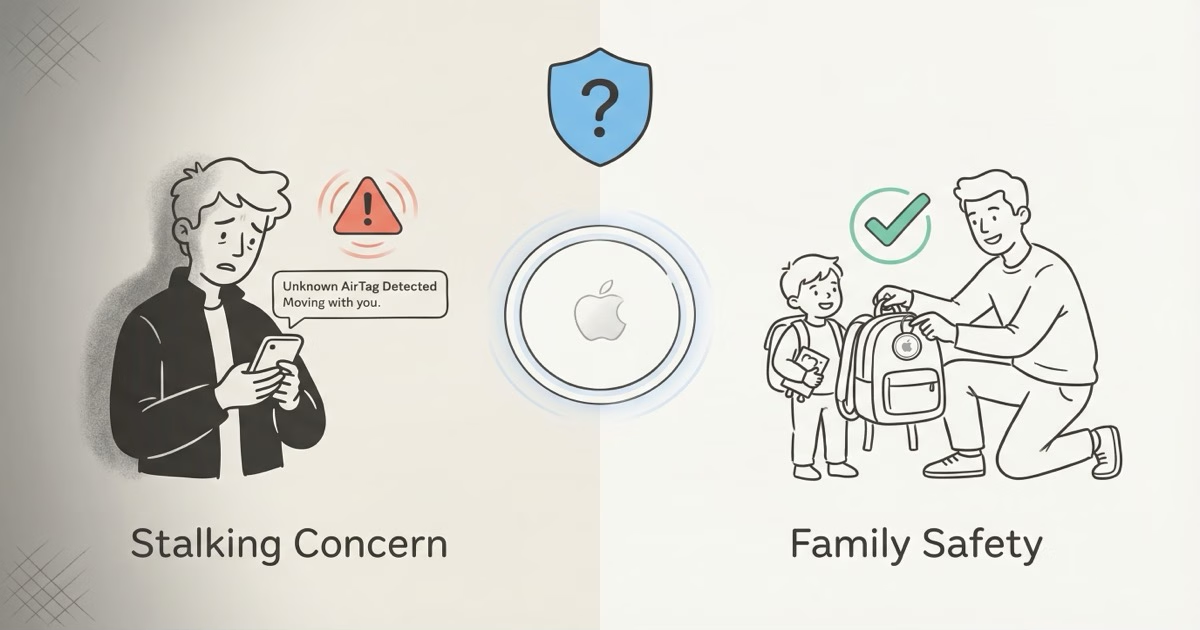
Yes, an AirTag placed on someone will report their approximate location whenever nearby iPhones detect it. But Apple has built anti-stalking safeguards that make sustained covert tracking difficult. iPhones alert you when an unknown AirTag travels with you, the AirTag itself beeps after 8-24 hours of separation from its owner, and any phone can tap the tag's NFC chip to identify who registered it. These protections are not bulletproof, but they turn AirTag stalking from easy to risky.
The question "can you use Apple AirTags to track people" pulls in two very different crowds. Some people are worried someone's tracking them right now. Others want to keep tabs on a child or elderly parent. The answer depends on context, consent, and how well Apple's safety features actually work. Here's what you need to know in 2026.
How AirTag Tracking Actually Works on a Person
AirTag doesn't have GPS. Zero. It piggybacks on Apple's Find My network, which spans over 2 billion active Apple devices worldwide. Any time an AirTag gets near an iPhone, iPad, or Mac, that device quietly sends the tag's Bluetooth signal to Apple's servers. The AirTag owner then sees a location update in their Find My app.
So if someone slips an AirTag into your bag, every iPhone you walk past becomes an unwitting relay.
In a busy city, location updates roll in every few minutes. Suburbs? Maybe every 15-30 minutes. Rural areas with few Apple devices around can go hours between updates. Accuracy per ping sits around 30-100 meters for standard Find My relays. The AirTag 2's upgraded Ultra Wideband chip brings Precision Finding down to centimeter-level accuracy, but only when the owner's iPhone is within about 60 meters of the tag.
What does that mean in practice? An AirTag can tell someone where you live, where you work, and roughly what your daily routine looks like. It can't stream real-time movement the way a GPS tracker with cellular service can. That's an important difference.
Apple's Anti-Stalking Protections in 2026
Apple took a lot of heat after the AirTag's 2021 launch for making stalking too easy. Since then, the company has stacked on protection after protection. The AirTag 2 (released January 2026) pushed several of these features further.
iPhone Unwanted Tracking Alerts
If an AirTag that isn't registered to your Apple ID travels with you for 8-24 hours (the exact timing is randomized), your iPhone sends a push notification: "AirTag Found Moving With You." Tap it and you'll see the tag's serial number, the last four digits of the owner's phone number, and options to play a sound or get directions. According to Apple's unwanted tracking support page, you can also use Precision Finding on compatible iPhones to pinpoint the tag's exact location near you.
Audible Beeping
After that same 8-24 hour window, the AirTag starts beeping on its own. The AirTag 2 is 50% louder than the original. Apple also redesigned the speaker module so it's harder to tamper with. On the first-gen AirTag, people drilled a small hole behind the battery to kill the speaker. Apple fixed that on the AirTag 2 with extra adhesive and a different internal layout.
Android Detection
Android users don't get the same automatic alerts iPhone users do. But Google and Apple co-developed an industry-wide standard for unwanted tracker detection, and Android 14+ now includes built-in "Unknown Tracker Alerts." It picks up AirTags, Samsung SmartTags, Tile trackers, and other compatible devices. If you're on an older Android phone, Apple's Tracker Detect app still works, but you have to open it and scan manually.
NFC Identification
Hold any NFC-capable phone (iPhone or Android) against the white side of an AirTag. A webpage pops up with the tag's serial number and partial owner contact info. This works even if the AirTag's battery is dead.
Law Enforcement Traceability
Every AirTag is tied to an Apple ID. When police get a court order, Apple hands over the name, address, and payment details linked to that account. Multiple stalking arrests in the US and UK have relied on exactly this process.
| Protection | How It Works | Limitation |
|---|---|---|
| iPhone alert | Notification after 8-24 hours of unknown AirTag traveling with you | Requires iPhone; 8-24 hour delay |
| Audible beep | AirTag beeps after separation window; AirTag 2 is 50% louder | Can be muffled in thick padding |
| Android detection | Built into Android 14+; manual scan via Tracker Detect on older versions | Older phones need manual app scanning |
| NFC tap | Any phone can read serial number and partial owner info | Person must know to tap it |
| Police traceability | Apple provides Apple ID details under court order | Requires police case and subpoena |
What to Do If You Find an Unknown AirTag
If your iPhone alerts you, or you physically find an AirTag you don't recognize, here's what to do. Don't panic, but don't shrug it off either.
Step 1: Tap the AirTag with your phone. Hold the top of your iPhone (or any NFC phone) against the white side of the tag. A website opens with the serial number and partial owner info. Screenshot it right away.
Step 2: Play the sound. Tap "Play Sound" from the notification to locate it. Check bags, jacket pockets, car wheel wells, under bumpers, and seat cushions.
Step 3: Document everything. Take photos of where you found the AirTag, the NFC scan results, and the notification on your phone. All of this becomes evidence if you file a police report. Write down timestamps and location details too. The more specific your notes, the stronger the case.
Step 4: Contact police if you feel threatened. File a report with the serial number. Officers can work with Apple to identify the owner. AirTag stalking cases have been successfully prosecuted across the US, with penalties that range from misdemeanors to felonies depending on the state. Don't wait around to see if it happens again.
Step 5: Remove the battery. Twist the back counterclockwise, pull out the CR2032. Keep the AirTag intact for police.
One thing people get wrong: don't leave the AirTag at a random location to "mislead" the stalker. That can complicate a police investigation and won't stop someone who's determined.
AirTag Stalking Is Illegal -- and States Are Getting Tougher
Tracking someone without their consent using an AirTag is a crime. Full stop. Every US state has electronic stalking or harassment statutes that cover Bluetooth trackers, and several states have passed AirTag-specific legislation since 2024.
Florida made it a third-degree felony (up to 5 years in prison) to install a tracking device on someone's property without consent, effective October 2025. If the tracker is used in connection with a violent crime, the penalty jumps to 15 years. Pennsylvania passed separate legislation making AirTag-based stalking a second-degree misdemeanor for first offenses and a first-degree misdemeanor for repeat offenses.
More states are following. The trend is clear.
Apple's terms of service also explicitly ban using AirTags to track people without consent. Every AirTag links to an Apple ID with a real name and payment method, so the no-subscription, no-anonymous-payment model creates a clear paper trail back to the stalker. This isn't a burner phone situation. Apple cooperates with law enforcement, and the evidence trail is strong.
Reports of AirTag-related stalking have jumped 317% since the 2021 launch, according to a Cybernews investigation. Most cases involve domestic situations: ex-partners, estranged spouses, custody disputes. Apple's protections won't stop someone from trying. But they do create the evidence that leads to arrest.
Legitimate Uses: Tracking Kids, Elderly, and Family Members
Not all people-tracking with AirTags is creepy. With consent and realistic expectations, an AirTag can give families a basic safety net.
Children's Backpacks and Belongings
Dropping an AirTag into a young child's school bag is one of the most common setups. You won't get real-time movement, but you'll see the bag's last detected location. Turn on Separation Alerts (Find My > AirTag > Notify When Left Behind) and you'll get a notification if the bag leaves a specific area like school or home. For kids under 10 who don't carry phones, it's a reasonable middle-ground.
For older kids who already have iPhones, Apple's built-in Share My Location (Settings > Privacy > Location Services > Share My Location) or Family Sharing is the better call. It gives real-time location, it's fully transparent, and your child can see that sharing is on. Put an AirTag in a teenager's bag without telling them? Their iPhone will flag it as a stalking alert. That defeats the purpose and damages trust fast.
Elderly Family Members
For a parent or grandparent with dementia who wanders, an AirTag in a jacket pocket or on a keychain holder offers a basic layer of protection. They should know about it and consent to wearing it. Our AirTag for elderly guide walks through the setup, including which holders actually stay attached.
The big catch: AirTag relies on nearby iPhones. Thin coverage means hours between updates. If someone's at serious wandering risk, a dedicated GPS tracker with cellular connectivity (like Jiobit or AngelSense) gives you real-time tracking that AirTag simply can't match.
Consensual Partner and Family Tracking
Some couples share AirTag locations willingly for safety while traveling or commuting. That's totally fine. But secretly tracking a partner is illegal and a serious red flag. Use Find My sharing instead.
AirTag vs. GPS Trackers for People Tracking
AirTag is a terrible choice for covert people tracking. It's basically designed to get caught.
A dedicated GPS tracker with cellular service (like Tracki or LandAirSea) gives you real-time location and geofencing, and it doesn't alert the person being tracked. That makes GPS trackers more useful for legitimate purposes (fleet management, teen driver monitoring with consent) but also more dangerous when misused.
| Feature | AirTag 2 | GPS Tracker (Tracki/LandAirSea) |
|---|---|---|
| Real-time tracking | No -- crowd-sourced updates only | Yes -- 15-60 second intervals |
| Anti-stalking alerts | Yes -- iPhone/Android notifications + beeping | No built-in alerts for the tracked person |
| Monthly fee | $0 | $8-25/month |
| Battery life | ~1 year (CR2032) | 1-2 weeks typical |
| Size | 31.9mm disc | Varies -- matchbox to deck of cards |
If your family's on board with it, AirTag wins on simplicity and cost. Need real-time updates for something like fleet monitoring? GPS trackers are the only real option. Neither should be used for stalking, obviously, but AirTag at least fights back.
The Bottom Line
Can you use Apple AirTags to track people? Physically, yes. But Apple's anti-stalking protections make it harder each year to pull off without getting caught. The AirTag 2's louder speaker, faster detection, and tamper-resistant design close gaps the first generation left wide open. If you find an unknown AirTag, tap it with your phone, grab the serial number, and call police. If you want to track a child or elderly family member with their knowledge, an AirTag in a bag or on a holder costs $29 with zero monthly fees. Just make sure everyone involved knows about it.
Frequently Asked Questions
Can someone track you with an AirTag without you knowing?
For a limited time, yes. But iPhone users get an "AirTag Found Moving With You" notification within 8-24 hours, and the AirTag beeps audibly after the same window. Android 14+ users also get automatic unknown tracker alerts. That window of undetected tracking has gotten much shorter since 2021. The AirTag 2's louder speaker makes the audible alert harder to miss, even when the tag is buried in padding.
How does an iPhone detect an unknown AirTag?
Your iPhone is constantly scanning for nearby Bluetooth devices as part of Find My. When it detects an AirTag registered to a different Apple ID that's been traveling with you for 8-24 hours (randomized), iOS fires off a push notification. You don't need to install anything. It runs in the background on iOS 14.5 and later.
Do Android phones detect AirTags?
Yes. Android 14+ has automatic "Unknown Tracker Alerts" built in for AirTags, SmartTags, and Tile trackers. No app install needed. Older Android phones can still use Apple's Tracker Detect app, but you have to open it and scan manually each time.
Is it legal to put an AirTag on your child?
Generally yes. No US federal law prohibits it. Put an AirTag in your child's backpack, let them know it's there (age-appropriately), and you're fine. For teenagers with iPhones, skip the AirTag. It'll trigger anti-stalking alerts on their phone and cause confusion. Use Family Sharing location instead.
What happens if someone uses an AirTag to stalk me?
Tap the AirTag with any NFC phone to get the serial number and partial owner info. File a police report with that serial number. Apple provides full Apple ID details (name, address, payment method) to law enforcement under court order. Florida classifies AirTag stalking as a felony with up to 5 years in prison. Pennsylvania treats first offenses as second-degree misdemeanors. Remove the CR2032 battery by twisting the back counterclockwise to immediately stop all tracking and sound emissions.
Can you disable an AirTag's anti-stalking alerts?
No. The owner cannot turn off the anti-stalking beep or prevent detection by other iPhones. Some people drilled out the first-gen AirTag's speaker. Apple fixed this in the AirTag 2 with a tamper-resistant speaker that is 50% louder. The "AirTag Found Moving With You" alert on iPhones is a system-level feature that cannot be disabled by anyone.
How far away can an AirTag track someone?
There's no range limit. AirTag uses the global Find My network, so it works anywhere iPhones exist: New York, Tokyo, rural France. The real limiting factor is iPhone density, not distance. Manhattan gives updates every few minutes. A national forest might go days without a single ping. Precision Finding works within about 60 meters on the AirTag 2 (up from 15 meters on the original), but that's only for the owner actively searching, not passive tracking.
Should I use an AirTag or a GPS tracker to keep my elderly parent safe?
In populated areas with mild risk, AirTag is a solid $29 safety net with no monthly fees. Serious wandering risk? You need a cellular GPS tracker like Jiobit or AngelSense. Those give real-time updates regardless of nearby phones and cost $10-25/month. Think of AirTag as a supplement, not a replacement for dedicated medical-grade tracking. Our elderly tracking guide breaks down the tradeoffs.