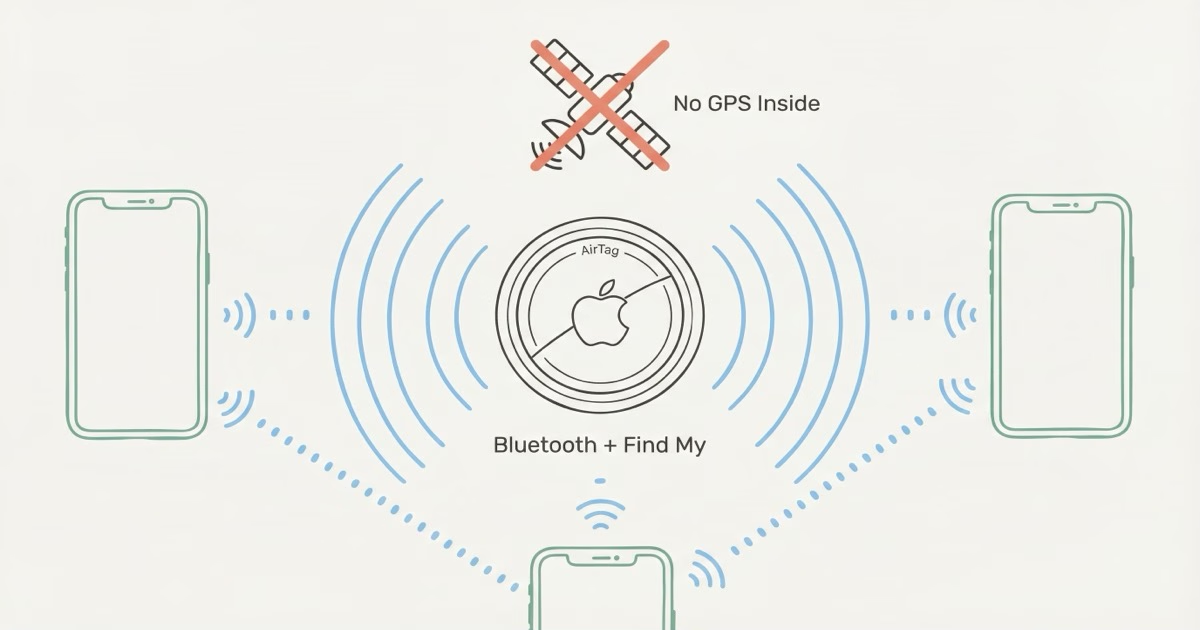
No. AirTag does not have GPS. There is no GPS chip, no satellite receiver, and no cellular antenna inside it. AirTag uses Bluetooth Low Energy to broadcast a signal, and nearby iPhones in Apple's Find My network pick up that signal and use their own GPS to report the location back to you. The AirTag itself never knows where it is.
This might be the single most common misconception about AirTag. People buy one expecting a GPS tracker that shows a live, moving dot on a map. Then they open Find My and see a static pin that's 20 minutes old. Apple markets AirTag as a way to "find your stuff," and most people hear "find" and think GPS. It doesn't work that way. AirTag takes a completely different approach, and knowing how it actually works will keep you from spending $29 on the wrong product.
Does AirTag Have GPS Inside It?
No. Open up an AirTag and you'll find three things: a Bluetooth 5.3 radio, an Apple-designed U2 Ultra Wideband chip, and a CR2032 coin cell battery. No GPS receiver. No cellular modem. No WiFi radio. Apple confirmed this in their official AirTag product page -- the word "GPS" appears nowhere in the specs.
Why Apple Skipped GPS
Power consumption. GPS receivers are hungry. A dedicated GPS tracker like the Tracki 4G burns through a rechargeable battery in 2-5 days with continuous tracking. AirTag's CR2032 coin cell lasts about a year. That's not a typo.
GPS also requires a cellular connection to send location data back to the owner. That means a SIM card, a data plan, and monthly fees from $5 to $25. AirTag skips all of that by piggybacking on other people's iPhones instead.
Then there's size. A GPS receiver, cellular modem, and rechargeable battery make a tracker at least the size of a matchbox. AirTag fits in a coin pocket. Apple chose to skip GPS entirely, use Bluetooth, and let the billion iPhones already out there do the work. That gave them a tracker that's 31.9mm wide and 11.8 grams. Small enough for a wallet card slot. You won't even notice it on a keychain.
What the Bluetooth Radio Does
One job: broadcast a rotating, encrypted identifier signal every two seconds. That signal reaches 10-30 meters in open air. Any Apple device running iOS 14.5 or later picks it up silently. The device owner never knows. Over a billion Apple devices are doing this right now, forming what Apple calls the Find My network.
How AirTag Tracks Location Without GPS
AirTag relies on Apple's Find My network, a crowd-sourced system built on over one billion Apple devices worldwide. The process works like this:
- Your AirTag broadcasts a rotating Bluetooth signal with an encrypted identifier
- A stranger's iPhone, walking past your parked car or sitting next to your bag at a cafe, detects that signal
- That iPhone uses its own GPS to record the current location, encrypts the data, and uploads it to Apple's servers
- Only you can decrypt and view that location in the Find My app on your iPhone
The stranger has no idea this happened. Apple can't see the decrypted location either. And the AirTag? It has no clue where it is. Every location you see in Find My came from somebody else's iPhone GPS, not from the tag.
Where This Works Well
Anywhere with lots of iPhone traffic. Airports, shopping malls, city sidewalks, train stations, college campuses. These places have so many iPhones walking through that your AirTag's location refreshes every few minutes. If you're tracking luggage through an airport, you'll probably see multiple pings as the bag moves from check-in to the carousel.
Where This Falls Short
Rural areas. If your AirTag is sitting in a field five miles from the nearest town, no iPhone might pass within 30 meters for days. Find My will show the last known location, which could be from when you drove past a gas station two hours ago. For scenarios where real-time tracking matters, like watching a car move live or tracking a pet across open farmland, a dedicated GPS tracker is the better tool.
International travel is similar. Countries with low iPhone adoption, like parts of Southeast Asia, much of Africa, and rural South America, will have spotty Find My coverage. Our international AirTag guide breaks it down country by country.
None of this is a flaw, though. It's Apple's deliberate trade-off: no monthly fees and year-long battery life, but location updates only happen when iPhones are nearby.
Precision Finding: The U2 Chip Is Not GPS Either
AirTag 2 has a second radio besides Bluetooth: Ultra Wideband (UWB) through Apple's U2 chip. Also not GPS. UWB is a short-range system that works directly between your iPhone and the AirTag.
When you're within about 60 meters of your AirTag, tap "Find" in the Find My app. Your iPhone sends UWB radio pulses to the AirTag, measures how long they take to bounce back, and calculates direction and distance down to a few centimeters. You'll see a directional arrow on screen pointing you right to it. Your phone vibrates when you're close enough to grab it.
The U2 chip in AirTag 2 is a big step up from the original's U1 chip. Apple's January 2026 announcement put the Precision Finding range improvement at 50% over the first-generation AirTag. The speaker got 50% louder too, which helps when the tag is buried in a couch cushion. Precision Finding now works on Apple Watch Series 9 and later, not just iPhones.
The catch: UWB only works when you're already close. It can't find an AirTag across town. You still need Find My to narrow things down to a general area, then drive there and use Precision Finding for the final 60 meters.
AirTag vs. GPS Trackers: When You Actually Need GPS
Most people asking "does AirTag have GPS" are really trying to choose between an AirTag and a dedicated GPS tracker. The right pick depends on what you're tracking and why.
| Feature | AirTag 2 | GPS Tracker (e.g., LandAirSea 54) |
|---|---|---|
| Location method | Bluetooth + Find My network | GPS satellites + cellular data |
| Update frequency | When an iPhone passes by | ✓ Every 3-60 seconds |
| Real-time tracking | ✗ No | ✓ Yes |
| Monthly fee | ✓ $0 | ✗ $15-25/month |
| Battery life | ✓ ~1 year (CR2032) | ⚠ 2-14 days |
| Size | 31.9mm, 11.8g | Typically 50-80mm, 30-60g |
| Works internationally | Wherever iPhones are common | Depends on cellular coverage |
Buy AirTag For These Situations
Keys, wallets, bags, luggage, backpacks. Anything you might misplace in daily life, in areas where other iPhone users exist nearby. AirTag 2 costs $29 once, has no subscription, and the battery lasts a year. For everyday item tracking, nothing else comes close on value.
Buy a GPS Tracker For These Situations
Vehicle theft recovery where you need to watch a car move live. Fleet management. Tracking a teenager's driving route. Following a dog across open farmland with zero foot traffic. All of these need continuous positioning, and AirTag can't do that.
The LandAirSea 54 works well for car tracking. It's magnetic, sticks under the chassis, and updates every 3 seconds with a live route on a map. The downside: $15-25 per month for cellular data, plus recharging every 1-2 weeks. A growing number of people use both, putting a GPS tracker on for real-time data and hiding an AirTag somewhere as a $29 backup that a thief probably won't find. For more options, check our no-monthly-fee GPS tracker guide.
Common Misconceptions About AirTag and GPS
Most AirTag frustration comes from expecting it to behave like GPS. These are the misunderstandings I see most often.
"My AirTag Shows the Wrong Location"
It's probably showing the right location, just from 20 minutes ago. The pin marks where the last iPhone detected your AirTag, not where the tag is right now. Left your bag at a restaurant and drove home? The pin should show the restaurant. If it shows a random street corner, that's where someone with an iPhone happened to walk past your bag most recently.
Check the timestamp in Find My. It tells you exactly when that detection happened. If the location isn't updating, it usually means no iPhones have passed within Bluetooth range since the last ping. Your AirTag isn't broken. Nobody walked close enough.
Here's something people miss: the pin's accuracy depends on where the detecting iPhone was standing, not where your AirTag actually sits. If someone was across the street when their phone caught the Bluetooth signal, the pin lands on the opposite sidewalk. That 10-30 meter discrepancy is normal and expected.
"AirTag Can't Track a Moving Object"
It can, just not in real time. If someone steals your bag and carries it through a city, every iPhone they walk past picks up the signal and sends a location update. You'll see a trail of pins on the map, not a smooth moving line. In busy urban areas, researchers have noted the billion-device Find My network produces something close to continuous coverage. But "close to continuous" still isn't the same as live GPS tracking.
How Accurate Is AirTag Without GPS?
It depends on which of AirTag's two systems you're talking about.
Find My network accuracy (remote): The pin in Find My is only as accurate as the GPS in whatever iPhone detected your AirTag. Modern iPhones land within about 3-5 meters outdoors, so the pin gets you to the right building, parking lot, or block. It won't tell you which room in a house or which shelf in a store. In practice, you drive to the general area and then switch to Precision Finding.
Precision Finding accuracy (close range): Under 10 centimeters in good conditions. This is the "follow the arrow" mode that kicks in within 60 meters. It works through walls and furniture, though thick concrete can block UWB signals. For real-world test results, see our AirTag accuracy guide.
Neither of these is GPS coming from the AirTag. One borrows GPS from a stranger's phone. The other uses UWB radio pulses between your own devices. The AirTag never connects to a single satellite.
The Bottom Line
AirTag doesn't have GPS, and Apple left it out on purpose. That's why it costs $29, has no subscription, and runs for a year on a coin battery. For tracking keys, bags, and luggage in places where iPhones are everywhere, the trade-off works. For real-time vehicle tracking or monitoring things in rural areas with no foot traffic, you need a GPS tracker with a monthly plan. Pick the tool that fits your actual situation, not the one with the fancier spec sheet.
Frequently Asked Questions
Does AirTag use GPS satellites to find your items?
No, there's no GPS receiver inside. AirTag broadcasts a Bluetooth signal that nearby iPhones pick up. Those iPhones record their own GPS coordinates, encrypt the data, and upload it to Apple's servers. You're borrowing GPS from strangers' phones without them knowing, which is why AirTag costs $29 once with zero monthly fees.
Can AirTag track in real time like a GPS tracker?
No. Updates only happen when a nearby iPhone detects the Bluetooth signal. In a busy city, that's every few minutes. In a rural area, it could be hours between pings. You'll never see a live-moving dot on the map like you would with a real GPS tracker.
How does AirTag know where it is without GPS?
It doesn't know where it is. The AirTag stores no position data at all. When a nearby iPhone catches the Bluetooth signal, that iPhone logs its own GPS coordinates, encrypts everything, and sends it to Apple. Only you can decrypt the location. The tag is just a beacon saying "I'm here" to any passing Apple device, and that device handles all the location work.
Does Precision Finding on AirTag 2 use GPS?
No. Precision Finding uses Ultra Wideband (UWB) radio through the U2 chip, which measures pulse timing between your iPhone and the AirTag to calculate direction and distance. It works within 60 meters and requires iPhone 11 or later. Satellites aren't involved at all.
Will AirTag work in a rural area with few iPhones?
Badly. AirTag needs nearby iPhones to relay its location, so sparse iPhone areas mean rare or zero updates. A hiking trail in a national park or an empty farm road could leave your AirTag silent for days. If you need rural tracking, get a cellular GPS tracker that connects directly to satellites and cell towers. Those give consistent updates regardless of how many people are walking around.
Is AirTag or a GPS tracker better for car theft recovery?
GPS tracker, no contest. When a car is stolen, you need real-time movement data to give police. A static pin from whenever the last iPhone happened to walk past won't cut it. The LandAirSea 54 updates every 3 seconds with a live route on a map. AirTag might eventually show the car's location once it parks near iPhone traffic, but that delay could cost you hours. Smart move: use both. GPS tracker for live pursuit, hidden AirTag as a $29 backup thieves probably won't find.
Does AirTag work without WiFi or cellular data?
The AirTag has no WiFi or cellular hardware. It only uses Bluetooth, which is always on. Other people's iPhones need an internet connection to relay the location data to Apple's servers, and your iPhone needs cellular or WiFi to pull up those locations in Find My. But the tag itself runs on Bluetooth alone and doesn't care about your home WiFi at all.