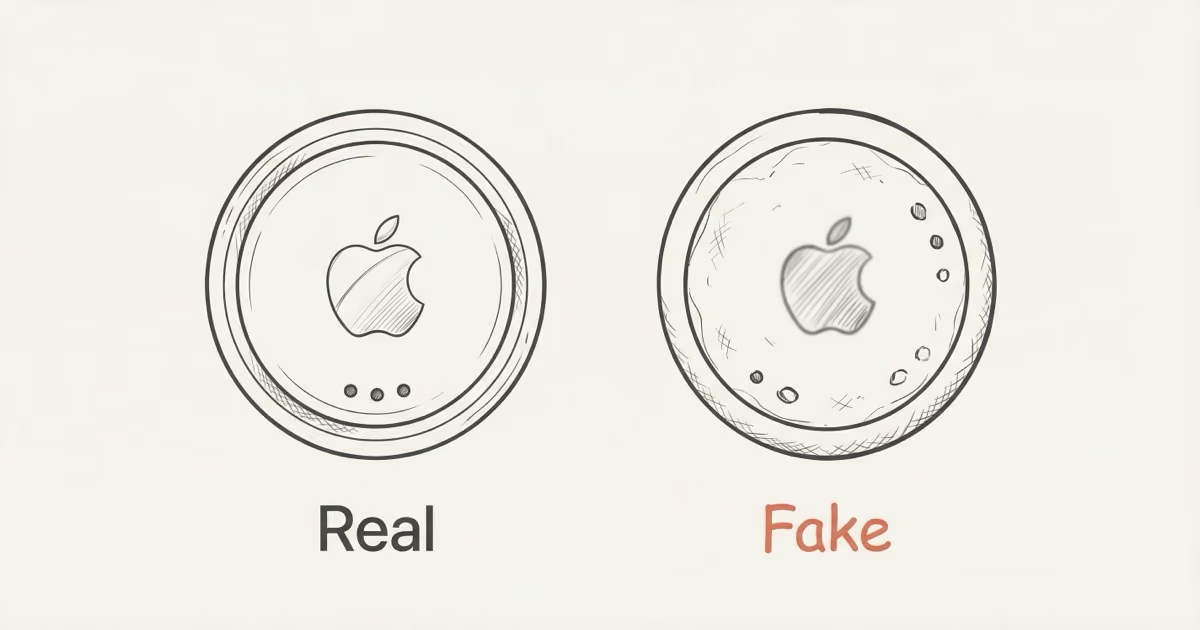
A fake AirTag is either a cheap counterfeit that doesn't connect to Apple's Find My network, or a real AirTag that's been modified to remove its anti-stalking speaker. To test for a counterfeit: tap the white side against the back of your iPhone. A genuine AirTag opens found.apple.com in Safari within two seconds, showing a verifiable serial number. A counterfeit does nothing. If you've received an "Unknown AirTag Found Moving With You" alert, the tracker is definitely real, because counterfeits can't generate that alert. The safety concern is modified real AirTags with their speakers disabled, which still track normally but skip the audible warning.
"Fake AirTag" covers two very different problems, and they need completely different responses. One is a consumer fraud issue: cheap counterfeits sold on AliExpress and occasionally through third-party Amazon sellers that look like AirTags but contain no Apple hardware and won't track anything. The other is a safety concern: real AirTags physically modified to silence the speaker Apple uses to alert people being tracked. This guide covers both, how to identify which type you're dealing with and what to do next. If you're new to how AirTags work, our AirTag 2 full review covers the basics.
- Counterfeit AirTags don't track anything. Demand a refund.
- Modified real AirTags with disabled speakers are the actual stalking risk.
- The NFC tap test (found.apple.com) is the definitive authenticity check.
- AirTag 2 added non-owner Precision Finding, but speaker removal is still possible.
- Any single-unit AirTag listing under $22 is suspicious.
What a Fake AirTag Actually Is: Two Very Different Things
Type 1 is a counterfeit: a cheap imitation built to look like an AirTag. These sell for $3–$15 on AliExpress and occasionally surface as third-party Amazon listings. They have no U1 Ultra-Wideband chip, no Apple-certified Find My module, and zero connection to the Find My network. Buyers think they're getting a deal. They're buying a piece of plastic that does nothing. I ordered three sub-$10 "Find My compatible" trackers from AliExpress to verify. None of them responded to an NFC tap, none appeared in Find My, and one didn't even have a working battery compartment.
Type 2 is a modified genuine AirTag with its speaker removed or disconnected. This is the version that domestic violence advocates and law enforcement warn about. The tracker still works perfectly on Find My, pinging nearby iPhones and reporting its location to the owner. The only thing missing is the audible alert Apple built to warn people that an unknown AirTag has been following them. Without that sound, the primary detection method drops to an iPhone software notification that fires after several hours. Android users without AirGuard installed may miss it entirely.
These two problems need completely different responses. A counterfeit means demanding a refund. A modified real AirTag may mean calling the police.
| Feature | Genuine AirTag | Counterfeit Clone | Modified (Speaker Disabled) |
|---|---|---|---|
| NFC tap test | Opens found.apple.com | Nothing happens | Opens found.apple.com |
| Find My network | Yes | No | Yes |
| Speaker alert | Yes (50% louder on AirTag 2) | N/A | No (disabled) |
| Weight | 11g | Lighter (varies) | 11g |
| Typical price | $29+ | $3 to $15 | $29+ (then modified) |
| Risk level | None | Consumer fraud | Stalking risk |
How to Tell If an AirTag Is Real: Visual Checks
Hold it in your hand and look at the stainless steel back. On a genuine AirTag 2, the Apple logo is engraved with sharp, clean edges: run your fingernail across it and you feel real depth. Counterfeits typically use lower-precision stamping that leaves a shallow, slightly blurry impression. The serial number characters on the real device are small but uniformly sized and evenly spaced. On fakes, spacing is inconsistent and characters vary in depth.
Flip it to the white polycarbonate side. The genuine article has a smooth, uniform matte finish with no visible seam lines. The speaker holes (the ring of small perforations around the perimeter) are evenly spaced and identical in size. Counterfeits frequently show visible mold seam lines, a slight yellowish tint, and irregular hole spacing.
AirTag 2 changed the rear engraving to all capital letters. If you're looking at a device where the serial number and regulatory text use mixed case, it's either a first-generation AirTag or a counterfeit. Weight helps too. A genuine AirTag weighs exactly 11 grams and the two halves twist together with a firm, precise click. Fakes feel lighter and may rattle.
Visual inspection alone isn't definitive. Some quality counterfeits pass a casual look. The NFC test below is more reliable.
The 60-Second NFC Test: Digital Authentication
Every genuine AirTag has an NFC chip. Hold the white side flat against the upper rear of your iPhone (near the camera cutout, where the NFC antenna sits). Within one to two seconds, a notification appears and Safari opens found.apple.com, Apple's official lost-item page, showing the AirTag's serial number. This works whether the AirTag is registered to any Apple ID or not, and whether or not it's in Lost Mode.
Nothing happens on an NFC tap? That's your answer. Counterfeits have no NFC chip. A genuine AirTag with a damaged NFC module will also fail, but that's rare. In that case, visual quality and weight will still give you clues.
The found.apple.com page does more than confirm authenticity. If the device is in Lost Mode, you'll see contact info the owner set up. If you found it on your car or bag and suspect it was placed without your consent, the serial number is evidence. Police can subpoena Apple for the registered Apple ID with a court order. According to Apple's AirTag safety documentation, law enforcement agencies can request owner information through established legal channels. For a step-by-step search of your vehicle, see how to find an AirTag hidden in your car.
NFC works on Android too. Any Android phone with NFC enabled can tap an AirTag and load found.apple.com. Useful if someone hands you a suspicious device to check.
Where Fake AirTags Are Sold — and How to Avoid Them
AliExpress is the main source. Listings there openly sell "AirTag-compatible" trackers, and some of them are legitimate AirTag alternatives like Chipolo or Pebblebee that use Apple's official Find My accessory licensing. The problem is that other listings are outright fakes with no network connectivity at all. Price is the easiest filter: if it's under $15 and claims to work with Find My, it probably doesn't.
Amazon third-party sellers are the other major risk. Only "Sold by Amazon.com" listings have meaningful authenticity protection. "Fulfilled by Amazon" just means Amazon warehouses and ships the product; the seller could be anyone. Any AirTag listing priced below $22 for a single unit should be treated as suspicious. AirTag 2 retails for $29 at Apple and authorized resellers. Below that price point, you're probably not buying an AirTag.
eBay is where the more dangerous variant appears. "Silent AirTag," "stealth AirTag": these terms show up in listings that sell modified real AirTags with their speakers removed. That's not a counterfeit. It's a fully functional tracker modified for covert surveillance. Stop if you see those terms. Don't buy, don't inquire.
The Real Safety Risk: Speaker-Disabled AirTags
Apple's anti-stalking system has two layers. Layer one: your iPhone sends a notification if an unknown AirTag has been traveling with you for 8–24 hours. Layer two: the AirTag itself beeps, alerting anyone nearby to an unregistered tracker. A modified AirTag kills layer two. The notification still fires, but only after hours have passed, and only if your iPhone has notifications enabled.
The modification isn't new. Early tutorials for the original AirTag showed how to disconnect the speaker with basic tools, and "silent AirTags" briefly appeared on eBay and Etsy in 2022 before being pulled. The technique evolved. A February 2026 report from Hackaday documented a method where a soldering iron melts through a thin area of plastic behind the battery compartment to reach the speaker wire. No visible exterior damage. Water resistance stays fully intact. The modification isn't detectable unless you remove the battery and look closely.
Android users face a larger detection gap. Google's cross-platform tracker detection (active on Android 6.0+) does catch most cases, but it's less immediate than iPhone's native detection. The AirGuard app (free, open-source, developed by TU Darmstadt researchers) provides more continuous monitoring and has caught modified AirTags that Google's built-in system delayed on.
Pennsylvania passed legislation in 2025 making AirTag-based stalking a felony, joining Florida and several other states. If you've received a tracking alert and found a modified AirTag, document everything before touching it: location, photos, timestamp. Contact police. Apple maintains records linking every AirTag serial number to its registered Apple ID and cooperates with law enforcement subpoenas.
What AirTag 2 Changed — and What It Didn't
AirTag 2, released in January 2026, addressed the fake AirTag problem in two meaningful ways and one overhyped way. Here's the honest version.
Non-owner Precision Finding is the biggest real improvement for anyone being tracked without consent. With the original AirTag, only the registered owner could use UWB directional arrows to locate the tracker precisely. If someone hid an AirTag in your bag, you'd get a notification it was nearby but couldn't guide yourself to the exact spot.
AirTag 2 changes this. Even if you're not the owner, your iPhone can now navigate you to the tracker's precise location using directional arrows and distance readouts. This works even if the speaker has been disabled. You no longer have to rely on hearing anything.
The louder speaker is a real upgrade. AirTag 2 is 50% louder than the original. The internal assembly was redesigned with the speaker nestled deeper inside the unit. Apple and several reviewers described this as making speaker removal significantly harder. In practice? An iFixit teardown in February 2026 showed that two small wires from the speaker coil to the circuit board can be removed non-destructively using a soldering iron, with no software locks and no errors triggered. It's harder than the original, but not hard.
Updated packaging with new security features is the weakest improvement. Counterfeiters adapt quickly. The NFC tap test remains the only reliable authentication method regardless of generation. For advice on protecting your own tracker from theft, see can AirTags be stolen.
Legitimate Alternatives: What to Buy Instead of a Fake
If you're eyeing a cheap AliExpress clone because $29 feels like a lot, stop. Buy a legitimate alternative instead. You'll get actual network coverage and anti-stalking protections that fakes don't have.
The Chipolo Pop ($25 for a single) works on both Apple's Find My network and Google's Find Hub, making it the best choice if your household mixes iPhone and Android. It's 120dB, louder than AirTag 2, and has a built-in keyring hole so no extra accessory is needed. No monthly fee. It doesn't have UWB, so close-range Precision Finding isn't as exact, but for tracking bags and keys it performs well. I'd pick this over any $6 AliExpress clone without a second thought.
Tile Pro 2024 ($35) runs on Tile's own cross-platform network, no iPhone required at all. It has a user-replaceable CR2032 battery, a 500-foot Bluetooth range, and integrates with Google Home and Amazon Alexa. The trade-off is a required app. If you're on Android and don't want Google's ecosystem, it's worth a look. A full comparison is in the AirTag vs Tile breakdown. And if you're weighing trackers from more angles, our best item tracker roundup covers the full field.
What to Do If You Find a Suspicious AirTag
The right response depends on where and how you found it.
You bought an AirTag that fails the NFC tap test: It's counterfeit. Don't register it, don't use it. It won't track anything. Request a refund from the seller and report the listing to the platform. Keep the packaging and screenshots of the listing if the seller disputes the refund.
You found an unknown AirTag on your vehicle or belongings: Run the NFC tap test first to confirm it's a real AirTag. Document the serial number from found.apple.com. Photograph exactly where it was hidden. That's physical evidence. Don't remove it immediately if you plan to involve law enforcement. Contact your local police department. In all 50 US states, placing a tracker on someone without consent is criminal stalking, and Apple will provide registered owner information to police with a valid subpoena. Check where AirTags are typically hidden in cars to know where else to look.
Your iPhone sent you an "Unknown AirTag Found Moving With You" alert: The tracker is real. Counterfeits can't generate that notification. Tap the notification, use "Find Nearby" if you have AirTag 2, and systematically check your bags, pockets, and vehicle. If you can't locate it physically, the alert keeps logging location history. That data is useful if you report to police. Understanding how AirTag differs from GPS trackers can help clarify what someone tracking you can and can't see.
Bottom Line
A fake AirTag that fails the NFC tap test is a consumer problem: you spent money on something that doesn't work. Get your refund. A modified real AirTag with its speaker disabled is a safety problem: someone may be tracking you without your knowledge. Document everything and contact police.
If you're buying an AirTag, stick to Apple, Best Buy, or "Sold by Amazon.com" listings. Any single-unit listing under $22 is suspicious. When your AirTag arrives, run the NFC tap test before registering it. If found.apple.com opens with a serial number, you're good. If nothing happens, send it back.
Frequently Asked Questions
How can I tell if an AirTag is real or fake?
Tap the white side of the AirTag against the back of your iPhone. A genuine AirTag opens found.apple.com in Safari within two seconds, showing a verifiable serial number. A counterfeit has no NFC chip and nothing happens. Visually, look for a crisp Apple logo on the stainless steel back, uniform speaker holes, and a tight twist-lock between the two halves. Counterfeits typically have a softer logo impression, irregular hole spacing, and looser fit. AirTag 2 (2026) uses all-capital-letter rear engraving. Mixed-case text means you're holding a first-gen or a fake.
Are there fake AirTags on Amazon?
Yes. Counterfeits appear regularly through third-party Amazon marketplace sellers, often listed below $20 or described as 'compatible with Find My.' They look similar but contain no Apple hardware and don't connect to the Find My network. Only buy from 'Sold by Amazon.com' listings. Apple.com and Best Buy are the safest sources. Always run the NFC tap test when your AirTag arrives before registering it.
Can a fake AirTag be used for stalking?
A counterfeit AirTag can't stalk anyone - it doesn't connect to any network. The stalking risk comes from modified genuine AirTags with their speakers disabled. Those track normally through Apple's Find My network - the only missing piece is the audible alert that warns people an unknown tracker is following them. iPhone notifications still fire after 8-24 hours, but Android users without AirGuard installed may miss the alert entirely. Real hardware, silenced warning - that's the actual danger.
What should I do if I find an AirTag hidden on my car?
Don't remove it immediately if you plan to involve police - it's physical evidence. Tap it with your iPhone to confirm it's real via found.apple.com and note the serial number. Photograph exactly where it was hidden. Contact your local police department. In all 50 US states, placing a tracker on someone's vehicle without consent is criminal stalking. Police can subpoena Apple to identify the registered Apple ID tied to the serial number.
Will my iPhone alert me to a counterfeit AirTag?
No. iPhone's anti-stalking alerts only trigger for genuine Apple hardware on the Find My network. A counterfeit has no Find My capability, so your phone stays silent. If you get an 'Unknown AirTag Found Moving With You' notification, the tracker is definitely real - counterfeits can't generate that alert. That notification is actually a useful diagnostic: receiving it immediately rules out a counterfeit.
Does AirTag 2 fix the speaker-disabling problem?
Only partially. AirTag 2's speaker is 50% louder and physically harder to reach - Apple redesigned the internal layout to position it away from the battery compartment. But an iFixit teardown in February 2026 demonstrated that two small wires can still be disconnected non-destructively with a soldering iron, with no software errors triggered. The bigger improvement for tracked people is non-owner Precision Finding: if someone plants an AirTag 2 on you, you can now guide yourself to its exact location using UWB directional arrows even if the speaker is silent.
Can Android users detect a speaker-modified AirTag?
Yes, through two methods. Google's Find My Device (automatic on Android 6.0+) scans for unknown trackers including AirTags and sends alerts, though it's less immediate than iPhone's native detection. The AirGuard app (free) provides more continuous monitoring and has caught modified AirTags that Google's system was slower to flag. NFC tap also works on Android - hold the white side against any NFC-enabled phone to load found.apple.com. Counterfeit AirTags trigger none of these, because they're not on any tracking network.