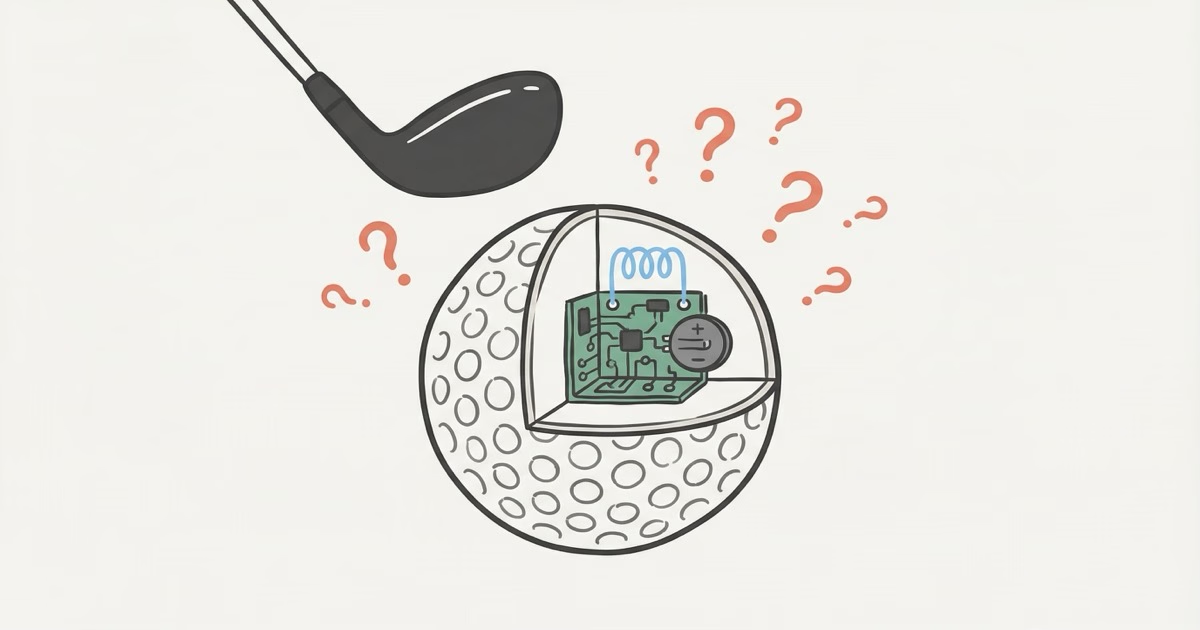
No reliable GPS golf ball exists for mainstream consumers in 2026. The impact force of a driver swing (2,000-4,000g) destroys embedded electronics, and USGA weight limits leave almost no room for a battery and chip. One product, the Chiping ball, uses Bluetooth BLE to help locate balls within about 30 yards, but it is not USGA-conforming and costs roughly $25 per ball. For most golfers, the practical move is tracking your bag with an AirTag and your shots with Arccos Caddie sensors.
Every golfer who has watched a $5 Pro V1 vanish into thick rough has had the same thought: why can't someone put a GPS chip in a golf ball? You search "golf ball with tracker," expecting to find something you can buy on Amazon and use this weekend. The reality is disappointing. A few products have tried. Most failed. One is technically available but comes with serious tradeoffs, and the alternatives that actually help golfers don't track balls at all.
Why a Golf Ball With a Tracker Still Doesn't Work
The physics are brutal. A driver strikes a golf ball at roughly 150-170 mph, producing 2,000-4,000g of deceleration in under half a millisecond. That force shatters silicon chips and cracks solder joints. The tiny antennas needed for Bluetooth or GPS signals don't survive either. This isn't a "we need smaller chips" problem. It's a materials science wall that no manufacturer has climbed.
Then there's the weight limit. The USGA equipment rules cap a conforming golf ball at 1.620 oz (45.93g) with a minimum diameter of 1.680 inches. A GPS chip, antenna, and battery capable of transmitting a useful signal would add 3-5 grams, pushing the ball over the limit or forcing manufacturers to gut core material that affects flight and spin. The rules do permit embedded chips for identification purposes, but a full tracking system is a different beast.
Several companies have tried anyway. The OnCore GENiUS ball embedded Bluetooth sensors to track spin rate, velocity, and approximate location. PGA Tour players were spotted testing prototypes at Colonial, and the GolfWRX forums lit up with excitement. The ball never reached mainstream retail. The Bridgestone e6 CONNECT used short-range Bluetooth to measure shot distance and was discontinued around 2019-2020. Neither lasted long enough to prove the concept works.
Chiping: The One GPS Golf Ball You Can Actually Buy
One product gets close to what golfers want. The Chiping golf ball, made in Switzerland, embeds a Bluetooth 4.1 (BLE) chip inside a two-piece ball construction. Pair it with the free Chiping app on your phone, and you'll see your ball's approximate location on a course map covering over 35,000 courses worldwide.
The tradeoffs are steep, though.
Tracking range tops out at roughly 30 yards. You need to be fairly close to the ball already for the signal to register. If your ball sailed 200 yards into thick trees, you're still walking and searching until you get within Bluetooth range. Most golfers lose balls somewhere between 50-150 yards from where they expected, which means you'll be outside Chiping's detection radius for the first several minutes of your search.
What Chiping Gets Right
For casual rounds where you're losing balls in light rough or just off the fairway, that 30-yard range is actually useful. The Chiping website claims most balls are found in under a minute. The app interface is clean, and pairing takes about two minutes. If you lose 3-4 balls per round in findable locations, Chiping could pay for itself in recovered balls within a few weekends.
What Chiping Gets Wrong
The ball is not on the USGA conforming ball list. Chiping claims it meets the technical specs, but it hasn't been submitted for official conformance testing. Can't use it in tournaments. For casual weekend rounds, that's fine. For competitive golfers, it's a dealbreaker.
Performance is the bigger concern. GolfWRX forum users and product reviewers describe the feel as "plastic and hollow," with reduced distance off the driver and less control on approach shots compared to premium balls like the Pro V1 or Chrome Soft. At roughly $25 per ball (a 12-ball expert set runs about $300), you're paying five times the price of a premium ball for worse performance plus a tracker that only works at close range.
Bluetooth also dies in water. Signals cut out within inches of submersion, so the tracker is useless in ponds and creeks. That's a problem, since water hazards are where most balls disappear for good.
Why You Can't Put an AirTag in a Golf Ball
People ask about this constantly. An AirTag is 31.9mm in diameter, 8mm thick, and weighs 11 grams. A golf ball is 42.67mm across and weighs 45.93g maximum. There's physically no way to embed an AirTag inside a conforming ball without blowing past the weight limit. Someone on YouTube tried hollowing out a ball and cramming an AirTag inside. It cracked on the first full swing.
Even if you could somehow fit one inside, the 2,000-4,000g impact force would destroy the AirTag's circuit board instantly. AirTags are built to survive a drop from a table, not a driver strike at 165 mph.
There is a better use for AirTags on the golf course, though. It just has nothing to do with tracking balls. Our AirTag accuracy guide covers how far Bluetooth actually reaches and what affects signal strength in real-world testing.
What Actually Works for Golfers Who Want Tracking
The products that solve real golfer problems don't try to track individual balls. They track your bag for theft and travel protection, and they track your shots for game improvement data. Both cost less than a season of lost Chiping balls, and neither requires embedding fragile electronics inside a projectile.
AirTag in Your Golf Bag
Drop an Apple AirTag 2 into an interior pocket of your golf bag. Done. Setup takes 30 seconds, and from that point your bag shows up in the Find My app with its last known location.
This solves three problems golfers actually have. Theft at the clubhouse: golf bag theft from parking lots and bag drops is surprisingly common, and an AirTag lets you track where your bag goes if someone walks off with it. Airline travel: if you ship your clubs or check them as luggage, you can watch the bag move through the airport system and know immediately if it misses your connection. Precision Finding on iPhone 11 and newer guides you to within inches of your bag using UWB, which is handy at large facilities with hundreds of bags lined up.
Our guide to using AirTag on the golf course covers placement tips and limitations. Golfers who fly internationally with their clubs should also check how AirTags work internationally and the AirTag in checked luggage guide.
Arccos Caddie Smart Sensors for Shot Tracking
Arccos Caddie is the closest thing to ball tracking that works in practice, and it does it by tracking your clubs instead. The Gen 4 system includes 16 sensors that screw into the butt end of your club grips. Each sensor detects impact and logs the GPS location automatically. No buttons. No manual entry.
After a round, the Arccos app shows you a complete shot map with every drive, approach, chip, and putt plotted on a satellite view of the course. You get actual carry distances for each club (not what you think you hit, what you actually hit), plus fairway accuracy percentages, greens in regulation, and strokes gained data. The AI Caddie feature analyzes over 1.5 billion shots from other users to suggest club selection and strategy based on your personal history.
It won't find your lost ball. But it answers a better question: where are you actually losing strokes? If your data shows you miss greens right 65% of the time with your 7-iron, or that your real 8-iron carry is 142 yards instead of the 155 you assumed, that information is worth far more than recovering a $4 ball.
Hardware runs about $200 for the sensor set. New users get a free first year of app membership; after that, a subscription unlocks the AI features and advanced analytics. A detailed Golf Monthly review of shot tracking devices compares Arccos against Garmin CT10 and Shot Scope.
Golf Ball Finder Apps and Visual Aids
If your main goal is just finding balls in the rough, low-tech solutions work surprisingly well. Shot Tracer records your swing and overlays a visible trace line on the ball's flight path so you know exactly where it went. Golf Ball Finder uses a blue filter on your phone's camera to make white balls pop against green grass.
Some golfers swear by golf ball finder glasses with blue-tinted lenses that boost contrast between the ball and surrounding vegetation. They cost $15-25 and don't need batteries, pairing, or subscriptions. Not high-tech. But effective.
Tracker Comparison for Golfers
| Feature | AirTag (in bag) | Arccos Caddie | Chiping Ball |
|---|---|---|---|
| Finds lost balls | ✗ No | ✗ No | ⚠ Within ~30 yards |
| Protects golf bag | ✓ Yes | ✗ No | ✗ No |
| Tracks shots | ✗ No | ✓ Yes (per club) | ✗ No |
| USGA conforming | N/A | N/A | ✗ Not listed |
| Monthly fee | ✓ None | ⚠ After first year | ✓ None |
| Cost | $29 one-time | ~$200 + subscription | ~$25 per ball |
| Works in water | N/A | N/A | ✗ No |
What About Radar-Enabled Golf Balls?
You may have seen TaylorMade's TP5 TRK-R or the Titleist Pro V1 RCT advertised as "trackable" golf balls. They exist, but they solve a completely different problem. Both contain a small amount of metallic material beneath the cover that reflects radar signals more consistently. They're built for indoor use with launch monitors like Trackman and FlightScope.
The TaylorMade TP5 TRK-R retails for about $65 per dozen. Titleist's Pro V1 RCT is similarly priced. Both play identically to their standard versions outdoors. But neither has any GPS, Bluetooth, or location-finding capability on the course. They won't help you find a lost ball. They help simulators and fitting studios get more accurate spin and launch data indoors.
If the marketing confused you, you're not alone. "Trackable" in the launch monitor world means "optimized for radar detection," not "findable with your phone." Our AirTag vs GPS tracker guide breaks down when each technology type makes sense for a broader look at Bluetooth versus GPS.
The Bottom Line
Don't buy a golf ball with a tracker expecting it to solve your lost ball problem. The technology isn't there yet, and the one product that exists (Chiping) trades ball performance and USGA conformity for a 30-yard Bluetooth finder. Put an AirTag in your golf bag for theft and travel protection, consider Arccos sensors if you want data to actually improve your game, and budget for ball losses as a normal cost of golf. If someone finally cracks the physics of a full GPS golf ball that survives driver impact at 165 mph, we'll update this page. Don't hold your breath.
Frequently Asked Questions
Is there a GPS golf ball you can buy in 2026?
The Chiping ball is the only trackable golf ball currently for sale. It uses Bluetooth BLE (not true GPS) with a range of about 30 yards. It's made in Switzerland and available through the Chiping website for roughly $25 per ball. It is not USGA-conforming and has mixed reviews on ball feel and distance performance. No true GPS golf ball exists at any price.
Can you put an AirTag inside a golf ball?
No. An AirTag weighs 11 grams and measures 31.9mm across. Too heavy for a conforming ball, too fragile for a driver swing. People have tried on YouTube. The ball cracked on the first hit.
What happened to the OnCore GENiUS ball?
OnCore pulled the plug before mainstream retail. They embedded Bluetooth sensors to track spin, velocity, and location, and PGA Tour players tested prototypes. Durability issues and the cost of mass-producing impact-resistant electronics killed the project. OnCore still makes regular golf balls, but the tracked version looks permanently shelved. No comeback timeline has been announced as of early 2026.
How does Arccos Caddie track golf shots?
Sensors screw into the butt end of each club grip and detect impact vibration. When you hit a shot, the sensor logs GPS coordinates automatically. After your round, the app maps every shot on a satellite view of the course with carry distances, accuracy stats, and strokes gained data. It tracks clubs, not balls, so it tells you where you played from rather than where the ball landed. Gen 4 sensors come in a set of 16 and include a free first year of app membership.
Are TaylorMade TRK-R or Titleist RCT balls trackable on the course?
No. Both are designed for indoor radar launch monitors like Trackman. They contain metallic material that helps radar read spin data more accurately in simulators. On the actual course, they play like normal premium balls with zero location-finding capability.
Will a GPS golf ball ever be possible?
Maybe, but the barrier is materials science. Electronics need to survive 2,000-4,000g of impact force hundreds of times without cracking. Flexible circuits and impact-resistant encapsulation are active research areas, but no commercial breakthrough has appeared yet. Even if one arrives, expect high prices and mandatory app pairing.
What is the cheapest way to stop losing golf balls?
Golf ball finder glasses with blue-tinted lenses cost $15-25 and boost visual contrast between a white ball and green grass. The Shot Tracer app records your swing and overlays a flight path line so you can see exactly where it went. Neither needs batteries or subscriptions. For about $30 total, both together cut ball loss more than any tracker on the market right now.