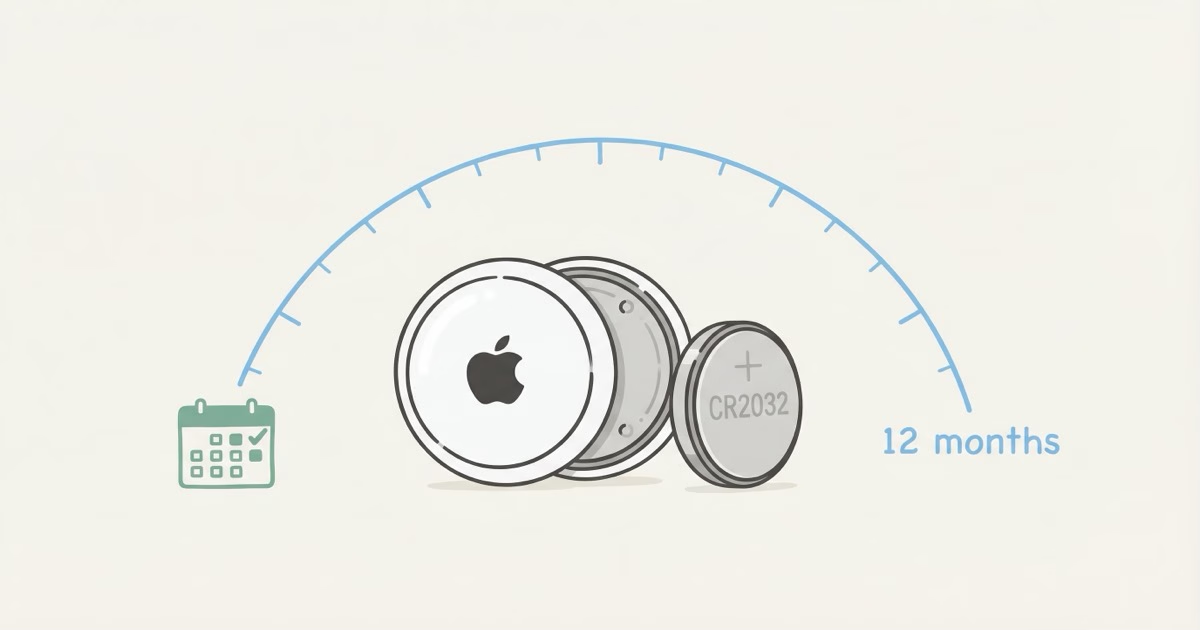
Apple rates AirTag battery life at "more than a year" using a single CR2032 coin cell. In practice, most users get 10-14 months before the low battery warning appears in Find My. Heavy Precision Finding use, cold weather, and cheap batteries can cut that to 8-9 months. A name-brand replacement CR2032 costs about $1.50.
That "more than a year" number from Apple assumes a specific usage profile: four Play Sound events and one Precision Finding session per day. Most people don't use their AirTags that actively, so plenty of folks report batteries lasting well past 12 months. But if you trigger Play Sound every morning to find your keys, or you live somewhere with brutal winters, your mileage will drop. Below, I'll break down what actually affects AirTag battery life, how AirTag 2 compares to the original, and the cheapest way to keep every CR2032 going as long as possible.
How Long Does AirTag Battery Really Last?
Apple's official claim is "more than a year" for both AirTag and AirTag 2. That's based on their standard usage profile: four sound events and one Precision Finding event daily. Fair enough as a benchmark. But your actual results depend entirely on how you use the thing.
An aggregated analysis of over 1,200 user-submitted battery logs from AirPinpoint puts the median replacement point at 12.4 months. Not bad. But the spread is huge: some users swapped batteries at 6 months, while others got past 20 months on a single cell.
Here's what typical scenarios look like:
| Use Case | Expected Battery Life | Why |
|---|---|---|
| Keys (daily carry, occasional Play Sound) | 10-14 months | Regular Bluetooth pings, some UWB use |
| Luggage (stored most of the year) | 14-18 months | Minimal activity when stationary |
| Car (left in vehicle year-round) | 8-12 months | Temperature extremes in parked cars |
| Dog collar (daily walks, frequent alerts) | 8-10 months | Movement + separation alerts + Play Sound |
| Wallet (rarely triggered) | 12-16 months | Low activity, room temperature |
The bottom line on lifespan: plan to replace the battery once a year. Set a calendar reminder for 11 months after inserting a fresh CR2032. If it lasts longer, great. But you won't be caught off guard.
What Drains AirTag Battery Faster
Precision Finding is the single biggest battery drain. When you open Find My and follow the directional arrow toward your AirTag, the U1 or U2 chip fires up Ultra Wideband radio to talk to your iPhone. That pulls way more current than a regular Bluetooth ping. One session won't matter. Twenty sessions a week? That'll shave months off your battery.
Play Sound
Each Play Sound command activates the AirTag's speaker for about 15 seconds. AirTag 2's speaker is 50% louder than the original, which means it draws more current per play event. If you're someone who rings your keys every morning, that adds up. Occasional use? Negligible impact.
Separation Alerts (Notify When Left Behind)
This feature keeps tabs on the Bluetooth connection between your iPhone and AirTag. When the AirTag drifts out of range at an unfamiliar location, you get an alert. That constant monitoring uses more power than passive beaconing. The extra drain is small on any single tag, but it's real. Users on Apple Community forums report separation alerts shave roughly 2-4 weeks off battery life over a full year.
You can add location exceptions (home, office) in Find My so the feature doesn't run checks where you don't need them. That'll claw back a bit of battery.
Cold Weather
Lithium batteries hate the cold. Below 0C (32F), a CR2032 can lose 20% or more of its effective capacity. Got an AirTag on a dog collar in Wisconsin, or inside a car sitting in a Minnesota lot all winter? Expect 8-10 months instead of 12. The battery does recover some capacity once it warms up, but repeated freeze-thaw cycles cause permanent damage.
Find My Network Density
In a dense city, your AirTag gets pinged by passing iPhones more often. Each ping uses a tiny amount of power, but it's not zero. An AirTag in Manhattan versus one on a rural farm in Montana? Probably a few weeks' difference. Nothing dramatic.
AirTag 2 vs Original AirTag Battery Life
Both use the same CR2032 battery, and Apple rates both at "more than a year." For everyday tracking, battery life is basically identical between the two generations.
The hardware is different under the hood, though. AirTag 2 runs the U2 Ultra Wideband chip (same one in iPhone 17 and Apple Watch Series 11) and has a louder, redesigned speaker. The U2 chip lets Precision Finding work from up to 50% farther away than the original U1 chip. But UWB transmissions are brief and infrequent during normal use, so standby power draw is about the same.
The one place you might see a difference: Play Sound. AirTag 2's louder speaker pulls more current each time it fires. A Tom's Guide review of AirTag 2 noted roughly the same battery life as the original during their testing period. For a full rundown of all 15+ differences, MacRumors published a detailed AirTag 1 vs AirTag 2 buyer's guide.
Bottom line here: don't expect AirTag 2 to outlast the original. Same battery, same ballpark.
How to Check AirTag Battery Level in Find My
Open the Find My app, tap Items, then tap your specific AirTag. The battery indicator shows up near the item name. Apple ditched the percentage readout in recent iOS versions. Now you get three states: Full, Low, and Very Low.
You'll also get a push notification when the battery hits "Low." That typically comes several weeks before the AirTag actually dies, so there's plenty of time to grab a replacement CR2032.
Keep in mind that a "Very Low" battery can reduce how often your AirTag broadcasts its Bluetooth signal. If you notice location updates becoming less frequent in Find My before you see a low battery alert, check the battery first. This matters most for AirTags used in cars where you want consistent position reporting.
Best CR2032 Batteries for AirTag
Buy Panasonic CR2032. That's the short answer. Across multiple independent tests, Japanese-made Panasonic cells deliver the longest life and steadiest voltage output, even in cold conditions.
Here's how the major brands stack up for AirTag use:
| Brand | AirTag Compatibility | Expected Life | Notes |
|---|---|---|---|
| Panasonic CR2032 | Excellent | 12-14 months | Best overall pick, no coating issues |
| Energizer CR2032 | Good | 11-13 months | Widely available, reliable |
| Duracell CR2032 | Check packaging | 10-12 months | Some versions have bitterant coating |
| Murata/Sony CR2032 | Excellent | 12-14 months | Great for cold environments |
| No-name/budget CR2032 | Risky | 6-9 months | Lower actual capacity, possible coating |
The Bitter Coating Problem
Since 2020, some battery manufacturers (Duracell being the main offender) have added a bitterant coating called Bitrex to CR2032 cells. It's a child-safety measure. The coating tastes awful so kids spit the battery out. Smart for safety. Terrible for AirTags.
That coating acts as an insulator, preventing proper electrical contact with AirTag's battery terminals. Apple published an official support article about AirTag battery replacement specifically warning about this. Symptoms: the AirTag won't power on after a battery swap, or it shows low battery right away with a fresh cell.
Newer Duracell packaging now says "compatible with Apple AirTag." If you're not sure, just go with Panasonic or Energizer. For the step-by-step swap process, see our complete AirTag battery replacement guide.
How to Maximize AirTag Battery Life
You can't double your battery life, but you can avoid cutting it in half. There's no power-saving mode on AirTag. No configurable broadcast settings. The battery draws what it draws. A few habits do make a real difference, though.
Use Precision Finding only when you actually need it. Don't open the directional arrow just to confirm your keys are in the house. If Find My already shows the AirTag at your home address, trust it. The UWB chip eats more power than anything else in the device, and people who fire it up multiple times a day report losing 1-2 months of battery life versus those who rarely use it.
Go easy on Play Sound, too. AirTag 2's louder speaker makes this worse. Before triggering another sound, check whether the beeping you hear is actually a low-battery alert.
Keep your AirTag out of extreme temperatures. A car dashboard in August or a ski jacket pocket in January will both kill the battery faster. If your AirTag is in a hidden spot in your car, pick somewhere insulated from temperature swings, like the trunk or under a seat.
And buy good batteries. Panasonic CR2032, sealed 5-pack, about $1.50 per cell. Done. No-name cells from a discount bin might have 30-40% less actual capacity than the label claims, and some come with that bitterant coating problem mentioned above.
Wondering if AirTags can be recharged instead of battery-swapped? Our guide on whether AirTags need to be charged explains why Apple went with the replaceable battery design.
The Bottom Line
AirTag battery lasts about a year. Plan for 10-14 months and you won't be caught off guard. Grab a 5-pack of Panasonic CR2032 cells, set a calendar reminder for 11 months, and stop thinking about it. The annual cost is under $2 per AirTag, there's no monthly fee, and the swap takes 30 seconds. Hard to beat that for a tracking device.
Frequently Asked Questions
How long does an AirTag battery last on average?
About 10-14 months with typical daily use. Apple's official "more than a year" rating assumes four Play Sound events and one Precision Finding session per day. If you rarely trigger your AirTag, 14-18 months from a single Panasonic CR2032 is common.
Does AirTag 2 have better battery life than the original?
No. Same CR2032 battery, same approximate one-year rating from Apple. The U2 chip and louder speaker draw slightly more during active use, but standby consumption is nearly identical.
What happens when AirTag battery dies?
It stops working entirely. No Bluetooth signal, no location updates, no sound. The last known location stays visible in Find My but won't refresh. To fix it, press down on the stainless steel back cover, twist counterclockwise, drop in a fresh CR2032, and twist the cover back on. Your Apple ID pairing survives battery changes, so there's no re-setup. Takes about 30 seconds.
Why did my AirTag battery die after only 6 months?
Usually one of three things: a cheap CR2032 with less capacity than advertised, a battery with bitterant coating causing spotty contact, or extreme temperature exposure (hot cars, freezing winters). Switch to Panasonic or Energizer and see if the next one lasts longer.
Can I use a rechargeable CR2032 in AirTag?
Apple doesn't recommend it, and I wouldn't either. Rechargeable LiR2032 cells output 3.6V instead of the standard 3.0V, which can damage the AirTag's circuitry over time. They also hold only 40-70mAh compared to 220mAh for a disposable CR2032, so you'd get a few months per charge at best. The math doesn't add up: a Panasonic CR2032 costs $1.50 and lasts a year. A rechargeable cell costs $5-8, needs a special charger, and dies every 2-3 months. Stick with disposable.
Does Notify When Left Behind drain AirTag battery?
A little bit, yes. It requires more frequent Bluetooth check-ins between your iPhone and AirTag. Users report losing roughly 2-4 weeks of battery life over a year with the feature turned on. For most people, the safety benefit is well worth that tradeoff. Even if you have separation alerts on five or more AirTags, the per-device impact stays small.
How do I check AirTag battery without an iPhone?
You can't. AirTag battery status is only visible through the Find My app on iPhone, iPad, or Mac. There's no LED indicator on the AirTag itself and no way to check from an Android device. If you suspect the battery is low, the only option is to open Find My on an Apple device or preemptively swap the CR2032.
Will removing the AirTag battery erase my data?
No. Everything is stored on Apple's servers through iCloud, not on the AirTag itself. Your Apple ID association, item name, settings, all of it. Pull the battery out, put it back in (or swap a new one), and the AirTag reconnects to your account automatically. The only way to actually unpair an AirTag is to remove it through Find My on purpose. Our guide on changing AirTag ownership covers the full unpairing process.